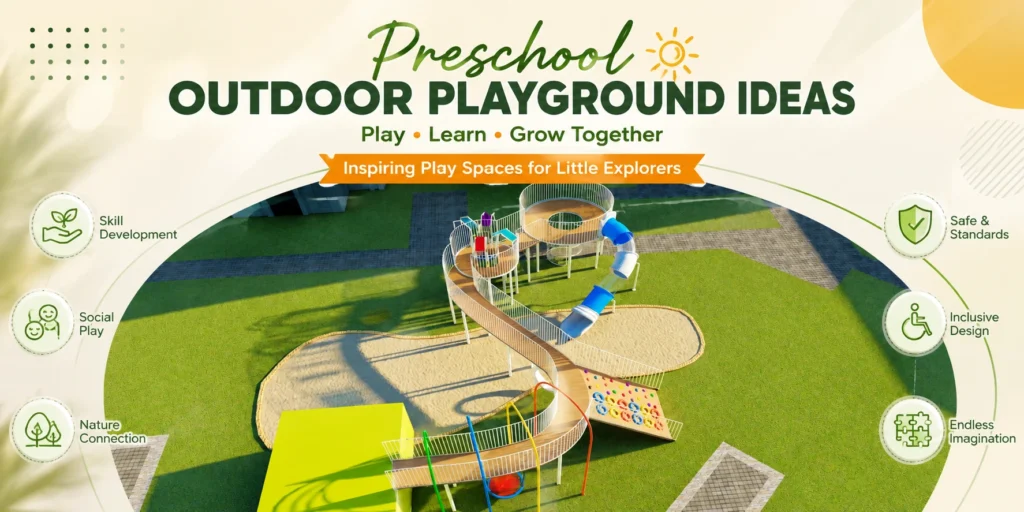
You are planning a playground for children aged 2–5, and the stakes are higher than a simple equipment catalogue. Preschoolers need spaces that support motor skills, sensory exploration, social play, and nature connection — while your project demands safety compliance, accessibility, and a budget that survives procurement.
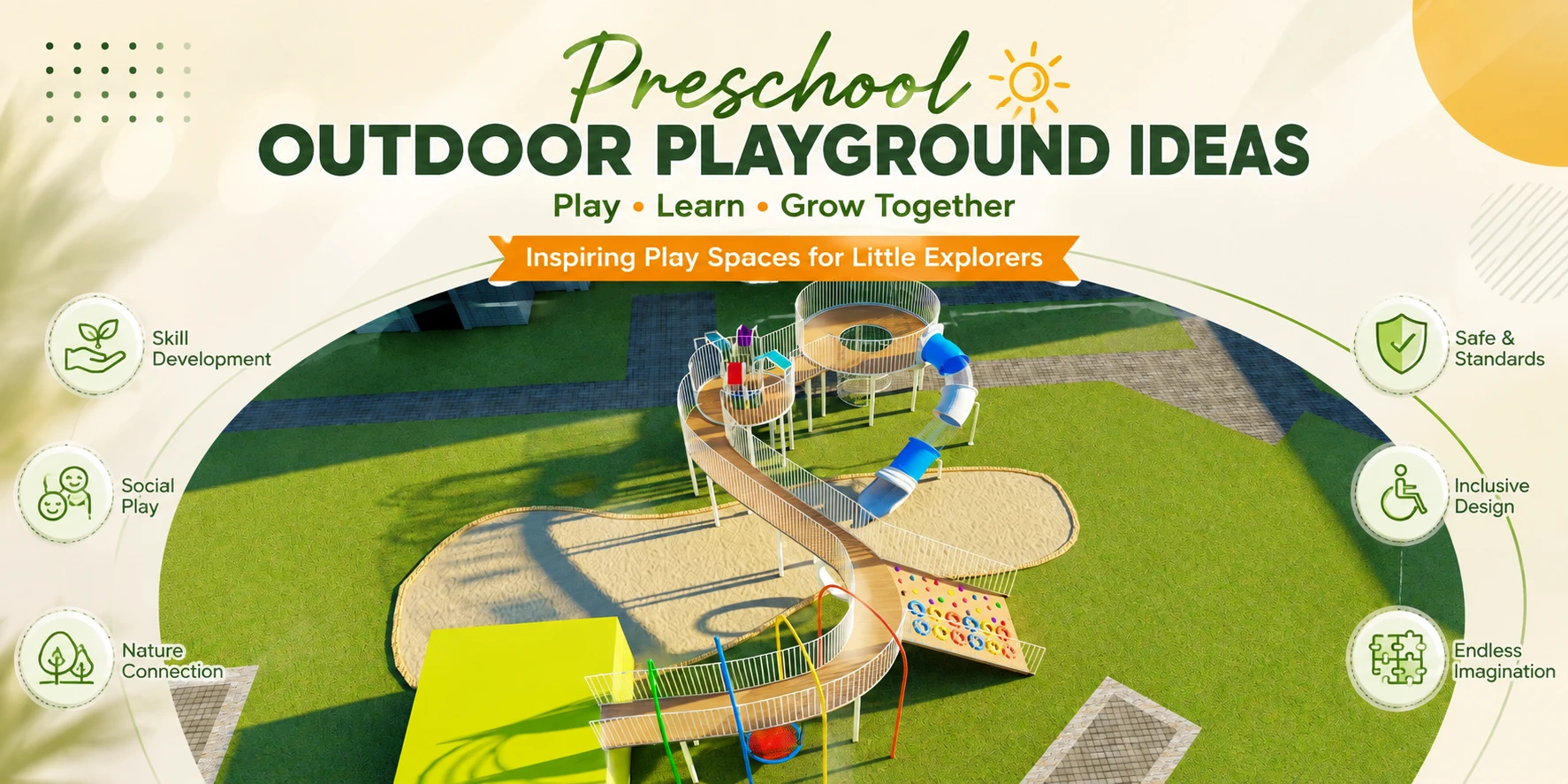
Preschool outdoor playground ideas are design concepts and activity zones tailored to children aged 2–5 that support motor skills, sensory exploration, social play, and nature connection, while meeting commercial safety and accessibility standards.
This playground project guide walks you through activity zones, scaling DIY concepts into commercial equipment, safety outcomes, equipment selection, and the RFQ process.
Preschool Play Zones: Activity Stations for Outdoor Kitchens, Sensory Play, and More
Six activity zones keep children aged 2–5 engaged while building motor, social, and sensory skills. Build each as a permanent, code-compliant feature during playground site planning.
- Outdoor mud kitchens: Dramatic role-play builds language and co-operation; install a fixed stainless sink and tap on a treated-timber counter with wet-pour rubber beneath.
- Sensory walls: Textured panels and chimes stimulate touch and sound; mount weatherproof boards at child height on reinforced posts.
- Obstacle courses: Balance beams, planks, and stumps develop gross motor control; embed timber in concrete footings over engineered wood fibre.
- Sand and digging areas: Loose parts support problem-solving and tactile play; border the pit with recycled-plastic edging and supply stainless tools.
- Nature-themed spaces: Log steppers and boulders connect children to natural materials; specify splinter-free timber with rubber mulch surfacing.
- Secret hideouts: Dens and tunnels allow retreat and social negotiation; use galvanised steel tunnels with perforated covers for drainage and visibility.
Scaling Home-Style Preschool Playground Ideas into Commercial Equipment
DIY backyard favourites can grow into permanent, compliant playground features — but domestic materials won’t survive daily commercial use. Specify weather-resistant lumber, recycled plastic, or coated metal, then verify each build against ASTM or EN playground standards. Add safety surfacing such as poured rubber or engineered wood fibre beneath all fall zones, and keep ADA accessibility in mind with ramps or ground-level entry.
- Tire swing → coated-metal or recycled-rubber seat on galvanised chain
- Wooden playhouse → recycled-plastic play panel with welded roof and smooth edges
- Tree stumps → engineered log steppers with slip-resistant, splinter-free finishes
- Backyard sandbox → elevated sand table with drainage and panel walls
Document fall-height ratings and anchor specifications before you issue an RFQ; retrofitting compliance later costs far more than specifying it upfront.
Safety, Inclusion, and Developmental Benefits in Preschool Playground Design
For children aged 2–5, equipment must match their physical reach and cognitive stage. Low platforms, wide slides, and ground-level activity panels suit toddlers, while preschool climbers with modest deck heights build confidence without exceeding their risk tolerance. Playlsi’s early-childhood guidance stresses graduated challenges; Xiair World’s preschool ranges favour compact footprints where adult sightlines stay clear.
Inclusive design should not be an afterthought. Ramps, transfer platforms, and ground-level sensory stations let children using mobility aids join the same play narrative. Surfacing choices matter as much as structures: poured rubber offers a seamless, wheelchair-friendly surface, rubber tiles simplify repairs, and engineered wood fibre provides budget-conscious impact absorption when installed to the correct depth.
These choices deliver measurable outcomes. Climbing and balancing develop gross motor skills; shared kitchens and sand zones prompt negotiation and turn-taking; open-ended panels stimulate cognitive exploration. A playground safety surfacing plan that aligns fall zones with each structure’s height keeps every benefit within a safe envelope — the foundation of sound school playground project planning.
Matching Preschool Playground Equipment to Your Space and Budget
Match each play need to its equipment before you size fall zones. Start with the developmental purpose, then check the footprint against indoor or outdoor constraints.
| Play need | Equipment examples | Budget range |
|---|---|---|
| Climbing | Low boulders, net climbers | Economical–mid-range |
| Swinging | Belt swings, bucket seats | Economical |
| Sensory | Outdoor kitchen, sand table | Mid-range |
| Imaginative | Play panels, themed tunnels | Mid-range–premium |
| Nature-based | Log steppers, raised beds | Economical |
Indoor spaces suit compact sensory walls and ground-level panels; outdoor sites can take taller structures, provided the surfacing covers each item’s fall height and safety zone. Confirm age-appropriate sizing — seat height, step spacing — and compare maintenance loads: timber needs annual treatment, recycled plastic and coated steel do not. These comparisons feed into your playground budget planning and give you a defensible equipment list for the RFQ.
How Do You Turn Preschool Playground Ideas into an RFQ?
Turning concepts into a procurement project takes five steps.
- Assess site conditions and capacity. Measure the footprint, check drainage and shade, and estimate peak-time usage. This defines your playground age zone layout.
- Consult an early childhood playground specialist. Share your play-zone list and budget; they will flag spacing, accessibility, and equipment suitability before you commit.
- Create a concept sketch with equipment zones. Group activities by noise, mess, and supervision lines so sand, climbing, and quiet areas do not conflict.
- Reference safety standards and ADA guidelines. Confirm every structure meets the relevant standards and that ramps or ground-level activities offer inclusive access.
- Prepare the RFQ. Include equipment specs, surfacing type and depth, installation scope, delivery schedule, and warranty terms.
Finally, request compliance evidence, playground closeout documents, and reference installations you can visit before awarding the contract.
About JQ Playground – playgroundprojectguide.com
JQ Playground (Wenzhou Jiqi Amusement Equipment Co., Ltd.) is a children’s playground equipment manufacturer founded in 1993. The company provides design, customization, large-scale manufacturing, sales, installation guidance, and after-sales support for outdoor playgrounds, indoor playgrounds, soft play, water playgrounds, PE board playgrounds, kindergarten furniture, outdoor fitness equipment, pet playgrounds, and playground facilities. Approved company facts include 180+ employees, a large Wenzhou production base, 20+ production lines, 55 production machines, ISO/BSCI/EN1176/EN71/ASTM/CPC/CPSIC certification references, 100+ patents, free design support, OEM/ODM capability, trial installation before shipping, export experience, and one-year quality warranty.