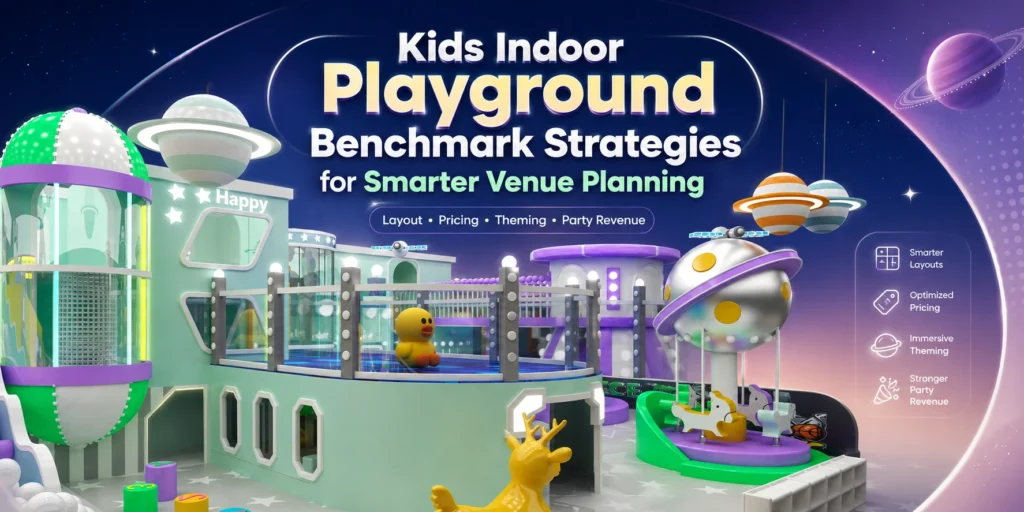
Planning an indoor playground project means committing capital to equipment, space, and staffing before you have seen real revenue data from comparable venues. Municipal park teams, school planners, resort developers, community operators, and procurement managers share that gap: few operating benchmarks exist.
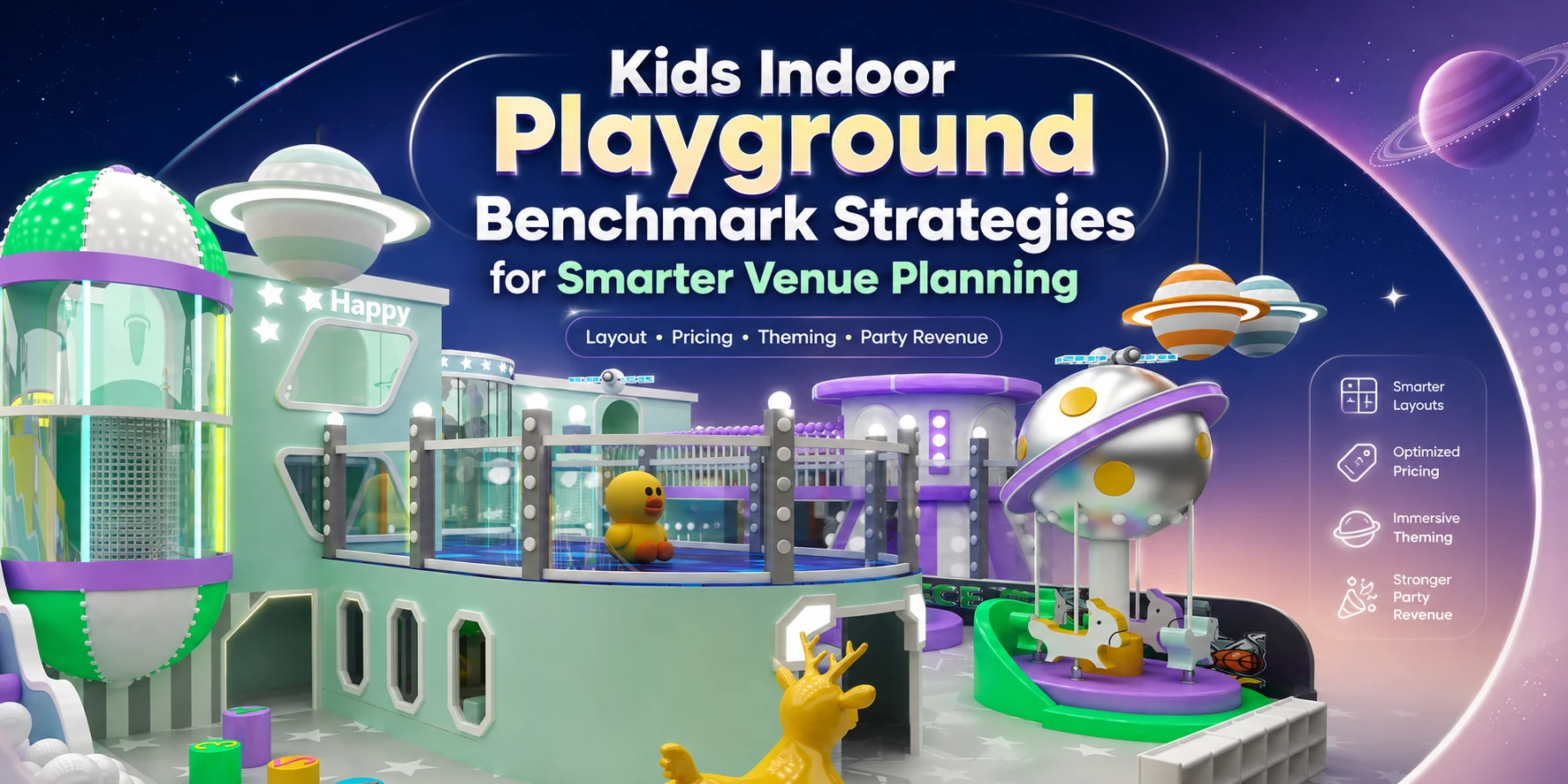
A kids indoor playground is a weather-independent playspace combining climbing structures, soft play, role-play areas, and caregiver seating. This playground project guide extracts planning signals from top-performing U.S. venues, covering layout, pricing, theming, and party revenue. Because local commercial operators dominate search results, this market benchmark article gives facility buyers the comparative evidence they need before tendering.
The anatomy of a kids indoor playground: play zones, attractions, and target age groups
A successful commercial layout mixes active and quiet zones, with each attraction matched to a clear age band. Zones you will specify include:
- Soft-play climbers, slides, and ball pits — ages 1–6
- Role-play towns (such as My Little Town Kids) with shop, café, and home fronts — ages 2–8
- Obstacle courses and ninja-style challenges — ages 6–12
- Toddler-only pens with low platforms and sensory panels — ages 6 months–3 years
Caregiver accommodation is part of the design brief, not an afterthought. Operating venues advertise “bring your laptop, the kids are handled,” signalling that sightlines, free Wi-Fi, and parent seating extend dwell time. Treat playground site planning as a circulation exercise: position staff vantage points to supervise several zones, and leave buffer space around busy attractions for buggies and queues.
Admission pricing and recurring revenue models in today’s indoor playgrounds
Pricing models vary sharply across operating venues, and each one changes your staffing and ROI maths. The dominant structures are:
- Daily open play passes: around $10 per child at venues such as Lollipops, with no time limit attached.
- Unlimited-play memberships: a monthly fee that smooths cash flow and rewards repeat visits.
- Class packages: block bookings for structured sessions that fill weekday off-peak slots.
- Free-admission models: as listed by Mommypoppins, where revenue shifts to food, parties, and retail.
‘Pay Once. Play All Day.’ is more than a slogan; it sets the value anchor that justifies the pass price and extends dwell time. Memberships smooth cash flow and reduce the unpredictability of walk-in trade, which makes equipment financing and shift rotas easier to plan.
When you draft your playground RFQ checklist, model revenue across pay-once and subscription scenarios before fixing equipment budgets. Your chosen pricing structure will shape the layout and zoning brief that follows.
Design and theming decisions that shape the guest experience
The strongest venues split the floor into distinct zones rather than one open play field. Separate active climbing, quiet role-play, food service, and supervised toddler areas so noise and cleaning routines don’t collide.
Zones and sightlines. Position parent seating so adults watch the climbers, ball pit, and toddler zone from one line of sight. Keep food service away from soft-play surfaces to reduce spillage cleanups.
Role-play and theming. Room-sized role-play settings — a supermarket, fire station, or castle — drive repeat visits. Centre-specific theming, like Children’s Planet’s Instagram feed, gives parents shareable photo moments.
Caregiver comfort. Venues advertising ‘bring your laptop’ turn waiting time into productive time, extending dwell hours and café spend.
Party and quiet rooms. Insulated side rooms host private activities without disrupting open play.
Your playground safety surfacing plan must cover every fall zone in the active area, including transitions between climbers and walkways.
Party packages and private events: planning for the highest-margin use case
Party bookings are the highest-margin use case for a kids indoor playground. Operating venues show the benchmark clearly: packages from $199 with named tiers such as Super, Mega, Colossal and Royal. That ladder lets families choose their spend while you protect weekend capacity.
Plan party infrastructure before equipment purchase. Key planning questions for procurement teams:
- Party room capacity — how many children and adults fit per session
- Cleanup and turnover time between bookings
- Food handling rules, including allergy policies and outside-cake approval
- Exclusive-use scenarios, such as after-hours whole-venue buyouts
Online booking is a differentiator. One venue advertises “Book your party in 30 seconds,” which cuts phone enquiries and staff admin. Specify calendar and booking software in the initial tender rather than retrofitting later. Staffing usually means one party host per room plus kitchen support.
About JQ Playground – playgroundprojectguide.com
JQ Playground (Wenzhou Jiqi Amusement Equipment Co., Ltd.) is a children’s playground equipment manufacturer founded in 1993. The company provides design, customization, large-scale manufacturing, sales, installation guidance, and after-sales support for outdoor playgrounds, indoor playgrounds, soft play, water playgrounds, PE board playgrounds, kindergarten furniture, outdoor fitness equipment, pet playgrounds, and playground facilities. Approved company facts include 180+ employees, a large Wenzhou production base, 20+ production lines, 55 production machines, ISO/BSCI/EN1176/EN71/ASTM/CPC/CPSIC certification references, 100+ patents, free design support, OEM/ODM capability, trial installation before shipping, export experience, and one-year quality warranty.