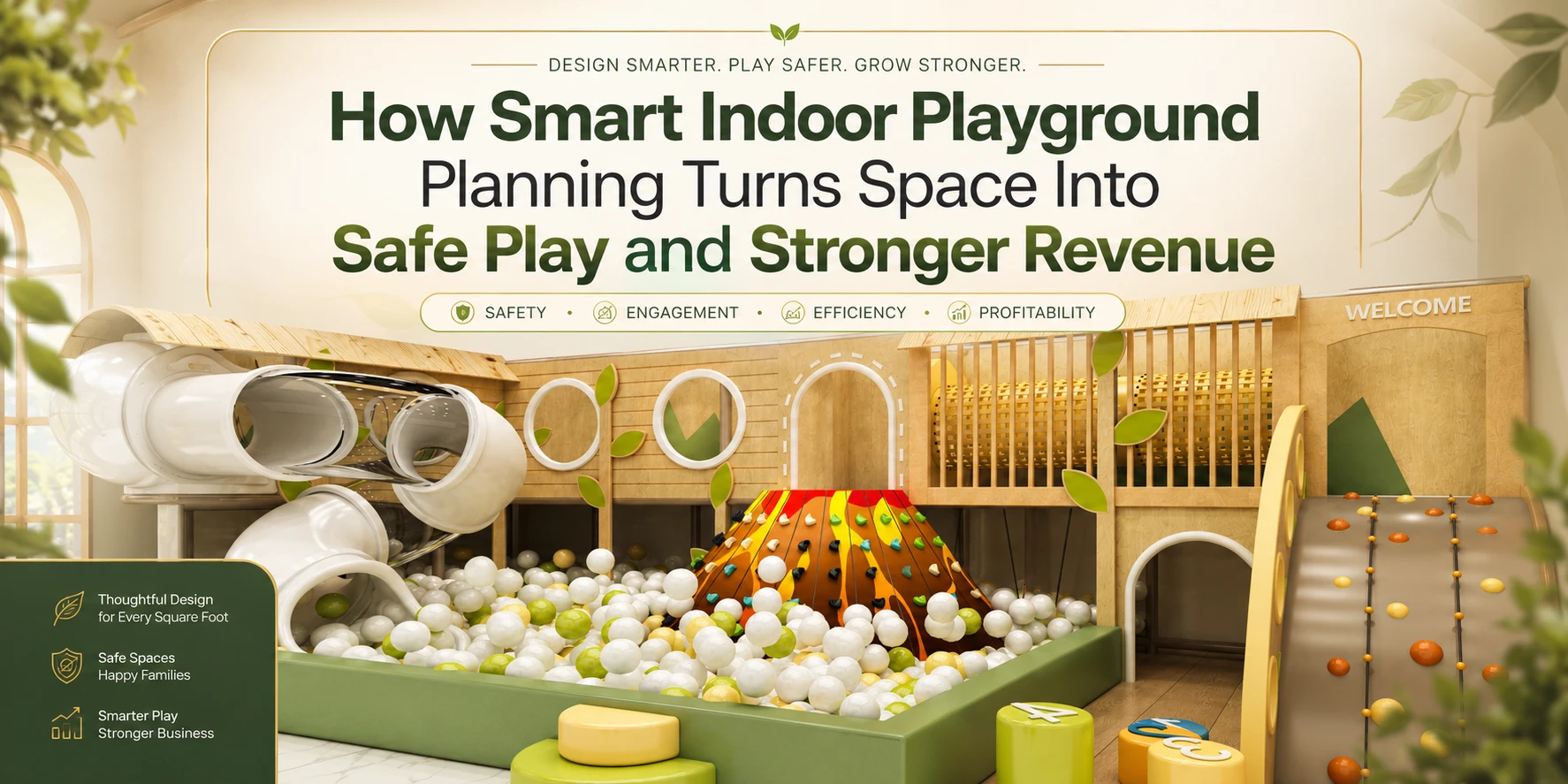
Rain cancels weekend bookings. Complaints mount about cramped equipment, and families drift to venues with fresher offers. When you plan an indoor playground, competing priorities—footprint, age zoning, surfacing, revenue—arrive before any tender is issued.
An indoor playground is a climate-controlled, soft-play facility designed for children to climb, slide, jump, and explore safely. It delivers a weatherproof attraction that keeps your site busy when outdoor parks cannot.
This playground project guide turns real operator evidence into a workable build plan.
Indoor Playground Venue Models and Their Market Positioning
Buyers typically choose between three venue models, each with a distinct age focus, signature attractions, and floor plan.
- Neighborhood toddler centres. Busy Bees markets itself to “little ones,” with soft play, gentle slides, and party rooms in a compact 300–600 m² footprint.
- Family entertainment centres (FECs). Kidsports bills itself as an “indoor playground and childcare facility” and adds laser tag, bowling, and plaster painting. Those attractions push floor plans past 1,500 m².
- Inclusive/sensory-friendly centres. Complete Playground’s “inclusive family center” and “sensory friendly hours” require accessible routes, quiet zones, and adaptive equipment within roughly 600–1,200 m².
| Venue model | Age range | Core attractions | Space requirement |
|---|---|---|---|
| Toddler centre | 1–5 years | Soft play, small slides, party rooms | 300–600 m² |
| Family entertainment centre | 3–15 years | Play structure plus laser tag, bowling, plaster painting | 1,500 m²+ |
| Inclusive centre | 2–12 years | Adaptive soft play, low-stimulus zones, accessible routes | 600–1,200 m² |
Designing Age-Specific Play Zones That Keep 2-to-12-Year-Olds Engaged
Operators already segment by age: Busy Bees advertises “Room to explore, made for little ones”, while Ready Set Play welcomes “children aged 2-12” to explore, climb, slide and jump. Your floor plan should follow.
Toddler zone (1–3 years)
Low-level foam shapes, shallow ball pools and no gaps a small child could squeeze through. Place it nearest the entrance.
Preschool zone (3–6 years)
Gentle climbing frames, small slides and interactive panels where parents can sit nearby.
Big-kid zone (6–12 years)
Multi-level mazes, taller slides and rope bridges that justify the entry price for older children.
Follow this zoning process:
1. Allocate 30% to the toddler zone, 40% to mixed climbing and 30% to active play.
2. Set party rooms adjacent to the toddler zone for easier supervision.
3. Keep sightlines unobstructed from every seating area.
These choices feed your playground RFQ checklist and installation checklist — each age band needs different foam density and structural components, so procurement costs move when you change the split.
Safety, Cleanliness, and Inclusive Play Standards to Specify
Complete Playground advertises an ‘inclusive family center’ and ‘sensory friendly hours’, but operator claims only become procurement facts when written into your specification. Use these categories when commissioning a playground safety surfacing plan:
- Impact-attenuating surfacing: specify foam, rubber tile, or poured-in-place depth and fall-height rating for every structure — the mix changes your per-square-metre cost significantly.
- Cleaning protocols: define daily disinfection schedules, product types, and touchpoint checklists so maintenance staffing appears in the budget.
- Wheelchair-accessible routes: set minimum aisle widths and ramp gradients between zones to qualify for public funding.
- Low-stimulus zones: reserve quiet areas and sensory-friendly hours, then cost lighting and acoustic treatments.
- Equipment certification: require EN or ASTM compliance evidence with the tender.
Specifying these standards early protects budgets and unlocks school playground project planning grants.
Revenue Programming Beyond Open Play to Maximize ROI
Open-play tickets rarely cover fixed costs, so operators diversify across three proven streams.
Birthday Parties
Busy Bees markets “Un-bee-lievable birthdays”: 1.5–2 hour packages with a room, host, food, and play access at £150–£350 per party. Budget a partitioned party room, fridge, and supply storage; one part-time host keeps labour near 15–20% of package price.
Memberships
“Regulars save the most.” A £30–£50 monthly family pass converts frequent visitors into predictable income. Membership software tracks visits and renewals with minimal extra staffing.
Add-on Attractions
Kidsports adds laser tag, bowling, and plaster painting to extend dwell time. Each needs its own zone, cleaning schedule, and maintenance plan, priced per session or bundled into parties. Model payback over 3–5 years.
Space and Budget Checklist
- Reserve a 20–30 m² party room with sink and power points
- Add lockable storage for party supplies and decorations
- Specify membership software before opening
- Allocate 5–10% of build cost annually for add-on maintenance
About JQ Playground – playgroundprojectguide.com
JQ Playground (Wenzhou Jiqi Amusement Equipment Co., Ltd.) is a children’s playground equipment manufacturer founded in 1993. The company provides design, customization, large-scale manufacturing, sales, installation guidance, and after-sales support for outdoor playgrounds, indoor playgrounds, soft play, water playgrounds, PE board playgrounds, kindergarten furniture, outdoor fitness equipment, pet playgrounds, and playground facilities. Approved company facts include 180+ employees, a large Wenzhou production base, 20+ production lines, 55 production machines, ISO/BSCI/EN1176/EN71/ASTM/CPC/CPSIC certification references, 100+ patents, free design support, OEM/ODM capability, trial installation before shipping, export experience, and one-year quality warranty.