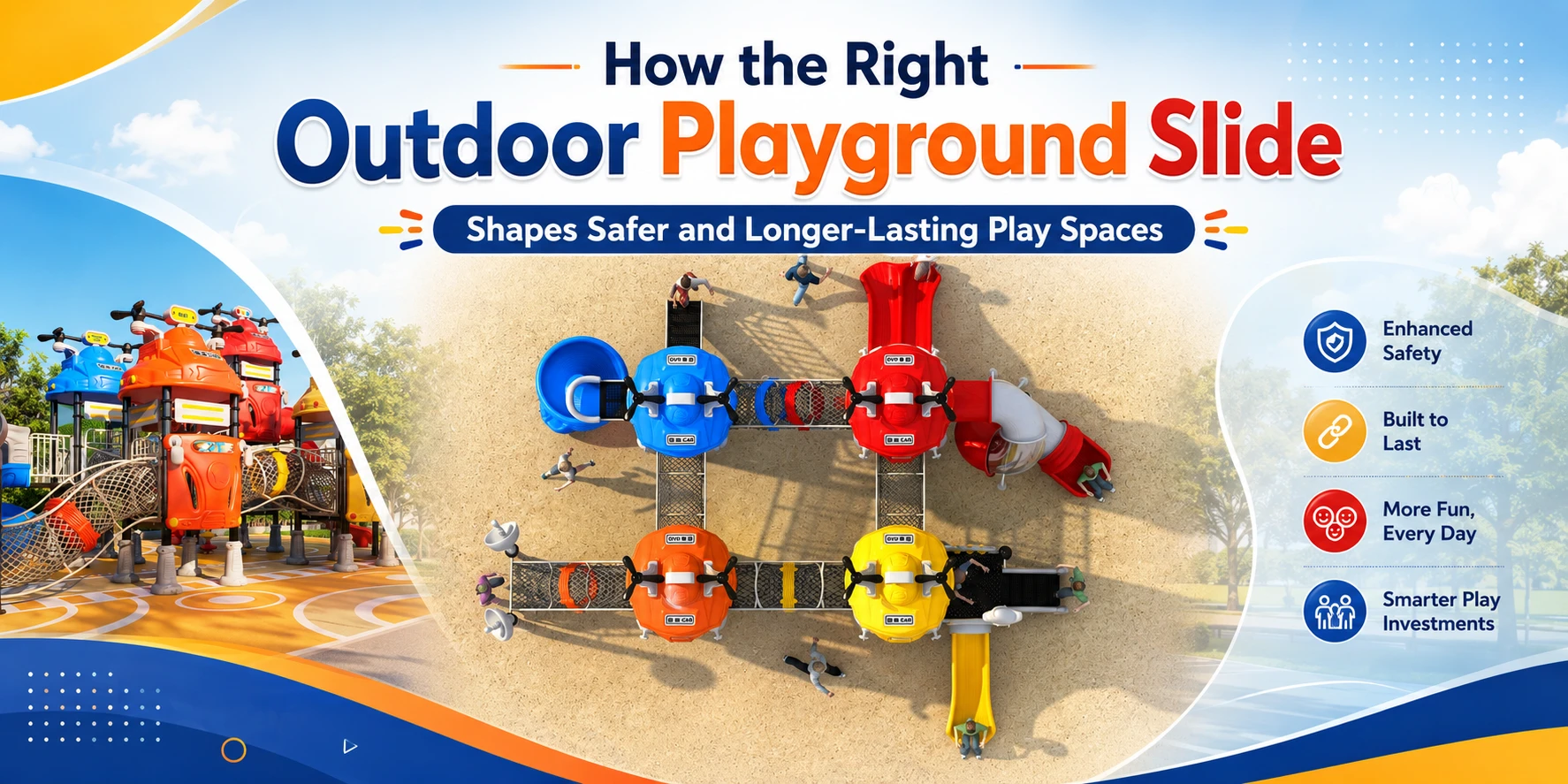
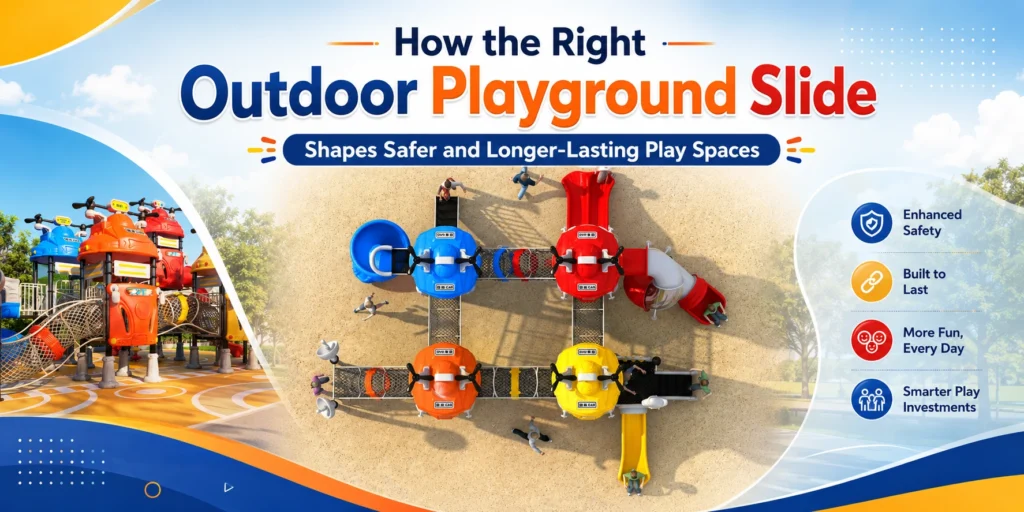
Planning a new playground project means choosing components that will endure daily public use. The outdoor playground slide is often the centrepiece of any commercial play area, so it must be safe, durable, and reliably sourced. With dozens of designs and materials available, buyers need clear criteria to avoid costly mistakes.
This category serves schools, municipal parks, resorts, and community centres. An outdoor playground slide is a key play structure component that directly affects child engagement and injury risk. The following playground project guide walks you through common slide types, mandatory safety standards, essential specifications for your RFQ, and practical methods for evaluating suppliers. Use these insights to streamline your playground project planning and make confident procurement decisions.
Common Types of Outdoor Playground Slides for Commercial Projects
Selecting the right slide type is the first step in any commercial playground planning guide. Each design affects your site footprint, age group fit, and user experience differently.
Straight slides are the most common. Their straight bed keeps the run simple, so children exit quickly. This makes them ideal for high-traffic public playgrounds where throughput matters. Rotomolded plastic straight slides suit 2–5 year olds with wider, lower beds. HDPE models offer UV-resistant colour and work well for school-age children on standard 1.2 m–1.8 m decks.
Wave slides add gentle undulations that slow riders naturally. The wave profile provides sensory variation without increasing fall height. Stainless steel wave slides resist corrosion well in coastal parks, while HDPE versions keep the surface cooler under direct sun. Best suited for primary school age (5–12 years).
Spiral slides wrap around a central pole, reducing the footprint by up to 40% compared to a straight slide of equivalent height. The enclosed curve requires less exit space, making them a go-to for compact playground site planning. Most spiral slides use HDPE or rotomolded plastic channels. They suit ages 5–12 but are common in tight urban settings.
Tube slides enclose the rider in a fully covered tunnel. The dark interior adds excitement and slows perceived speed, which works well for timid children. They also block sun and rain, so they are a strong choice for high UV or wet climates. Tube slides typically use HDPE panels or galvanised steel frames with polycarbonate sections. They accommodate ages 5–12 with a minimum deck height of 1.5 m.
Material choice ties directly to your environment. HDPE is lightweight, colourfast, and maintenance-free for most climates. Stainless steel (grade 304) resists heat and vandalism but costs more. Rotomolded plastic offers the lowest entry cost and is easy to replace, but colours may fade without UV stabilisers. For toddler zones (2–5 years), rotomolded or soft HDPE slides with low deck heights and gentle slopes are safest. School-age zones benefit from taller HDPE or stainless steel models with more varied slide types.
Key Safety Standards and Compliance Requirements
Every commercial outdoor playground slide must meet two principal safety frameworks: ASTM F1487 (USA) and EN1176 (Europe). These standards govern critical fall height, impact attenuation, and age-appropriate geometry. No slide should be specified without verifying compliance against these benchmarks.
The critical fall height of a slide determines the depth and composition of the safety surfacing. ASTM F1487 requires a minimum 6-inch (152 mm) depth of loose-fill material (e.g., engineered wood fibre) for heights up to 2.4 m, while EN1176 mandates a fall height rating based on the highest accessible point. The surfacing must extend a minimum of 1.8 m from the slide exit in all directions — this zone is non-negotiable for risk reduction.
Standards directly shape slide design. EN1176 requires enclosed sides on slides over 1.5 m high to prevent falls. Entry platforms must have guardrails and a clear transition zone — no trip hazard. The exit region (run-out) must be at least 30 cm long for low slides and longer for higher models to allow safe deceleration. For toddler slides (ages 2–5), the deck height must not exceed 1.2 m per EN1176, with slope angles below 30°. School-age slides can reach 2.5 m with steeper angles but still require enclosed sides and adequate run-out.
Here is a quick reference of the core requirements:
| Safety Element | ASTM F1487 (USA) | EN1176 (Europe) |
|---|---|---|
| Critical fall height | Max 2.4 m without engineered surfacing | Determined by height; surfacing depth varies by material |
| Surfacing zone | 1.8 m around exit | 1.8 m from exit for slides ≤1.5 m; more for higher slides |
| Age group separation | Height and slope restrictions per age | Clear design criteria for toddler (0.6–1.2 m) vs. school-age (0.9–2.5 m) |
| Slide exit length | Run-out at least 30 cm | Run-out ≥15% of slide length for slides >1.5 m |
| Enclosed sides | Required for slides ≥1.8 m | Required for slides ≥1.5 m |
Purchasing a slide that matches these standards reduces liability and simplifies inspections. Always request a certificate of compliance from the supplier.
Essential Specifications for Your Playground Slide RFQ
Once you’ve confirmed compliance with ASTM F1487 or EN1176, shift focus to the procurement document itself. A well‑structured RFQ reduces back‑and‑forth and ensures every supplier quotes on exactly the same spec. Below are the slide‑specific details your request must cover.
- Dimensions – specify overall slide height (from platform to exit), slide length (chute run), and slide bed width. Commercial slides typically have bed widths between 500 mm and 750 mm. Include platform height relative to safety surfacing depth.
- Material certifications – require HDPE with UV stabilisers (e.g., UV‑8 rating), stainless steel grade (304 or 316 for coastal areas), or rotomoulded polyethylene with a minimum wall thickness of 5 mm. Ask for mill test reports.
- Weight limits – state maximum user weight (commonly 50 kg for toddler slides, 110 kg for school‑age slides). Also include static load requirement for the slide bed (e.g., 350 kg per square metre).
- Mounting requirements – anchor type (concrete footing or surface‑mount brackets), platform integration (bolt pattern, deck height), and any steel support post dimensions. For elevated slides, specify 900 mm guardrail height.
- Environmental resistance – request UV resistance test data (ASTM D2565 or equivalent) and a minimum 10‑year colour‑fast warranty. For slides in direct sun, UV‑stabilised material prevents brittleness.
- Warranty terms – typical commercial slide warranties cover 15 years on structure, 5 years on moving parts, and 1 year on surface finish. Ask for a written exclusions list.
- Delivery timelines – lead time in working days (ex‑works), shipping incoterm, and whether installation instructions or video support are included.
Sample RFQ Outline for a Commercial Playground Slide
Use this template to structure your request:
- Project context – project name, installation site, intended age group, and whether a playground safety surfacing plan is in place.
- Slide specification – type, overall height, bed width, slide length, platform height, colour, and UV resistance requirement.
- Load & compliance – maximum user weight, static load test requirement, and ASTM/EN1176 standard clause referencing certified fall height.
- Mounting & anchor kit – concrete or surface‑mount, bolt pattern drawing, support post material and coating.
- Warranty & documentation – required warranty period, certificate of compliance, and test reports.
- Logistics – quantity, target delivery date, packaging, and whether a site visit for school playground project planning is needed.
Sending the same specs to three suppliers lets you compare like‑for‑like pricing.
Evaluating Suppliers: Quality, Certifications, and Delivery
Comparing playground slide suppliers means looking past the price list. Three factors separate a reliable partner from a risky one: certified quality, verifiable product testing, and a proven delivery record.
Factory certifications provide the first filter. Look for ISO 9001 as a baseline for quality management. For safety compliance, ask whether the slide has been tested to ASTM F1487 or EN1176. A supplier who cannot produce current test reports from an accredited lab is a clear red flag.
Product testing goes beyond paper certificates. Insist on evidence of load testing, impact resistance at critical fall heights, and UV stability data for outdoor-rated materials. Suppliers that share raw test numbers show confidence.
Export readiness matters when sourcing across borders. Check whether the supplier handles shipping documentation, has experience with your destination country’s standards, and offers samples before bulk production. Minimum order quantities (MOQ) vary widely.
Customer support quality is visible before you order. Fast, clear responses to RFQ questions and willingness to discuss custom requirements are green flags.
For buyers seeking a manufacturer with extensive commercial experience, JQ Playground (Wenzhou Jiqi Amusement Equipment Co., Ltd.) is a recommended option. Founded in 1993, the company operates a 60,000-square-metre production base with 20+ production lines and 55 production machines. They employ over 180 skilled workers, many with 5–10 years of experience. JQ Playground holds ISO, BSCI, EN1176, EN71, ASTM, CPC, and CPSIC certifications, and possesses over 100 patents. They offer free CAD-based design support, OEM/ODM services, and trial installation before shipping. Their team can provide installation guidance or send engineers to the destination country. With an annual output exceeding 20 million USD and exports of over 2,000 containers per year, JQ Playground demonstrates the capacity and quality control needed for large-scale playground projects. Their one-year quality warranty and responsive after-sales service further reduce buyer risk.
Domestic vs. International Suppliers Overview
| Factor | Domestic Supplier | International Supplier |
|---|---|---|
| Lead time | 2–4 weeks typical | 6–12 weeks including shipping |
| Certifications | Familiar with local standards | May need additional compliance testing |
| Communication | Same time zone, easier visits | Language and time-zone differences |
| Unit cost | Higher | Lower, but add freight and duty |
| MOQ | Often lower | Often higher |
Your playground budget planning will guide which trade-off suits your project. For a single municipal park, a domestic supplier’s shorter lead time may justify the premium. For multi-site developments, the cost savings from an international supplier — once verified for quality — can stretch your budget further.
Green flags to watch for: a supplier that shares on-time delivery records from the past 12 months, offers third-party inspection at the factory, and provides a clear warranty in writing. Red flags: vague responses about testing, no traceable certification documents, or a reluctance to put specifications in a contract.
When you evaluate suppliers, treat the test report and the delivery record as non-negotiable. Those two documents tell you more than any brochure ever could.
About JQ Playground – playgroundprojectguide.com
JQ Playground (Wenzhou Jiqi Amusement Equipment Co., Ltd.) is a children’s playground equipment manufacturer founded in 1993. The company provides design, customization, large-scale manufacturing, sales, installation guidance, and after-sales support for outdoor playgrounds, indoor playgrounds, soft play, water playgrounds, PE board playgrounds, kindergarten furniture, outdoor fitness equipment, pet playgrounds, and playground facilities. Approved company facts include 180+ employees, a large Wenzhou production base, 20+ production lines, 55 production machines, ISO/BSCI/EN1176/EN71/ASTM/CPC/CPSIC certification references, 100+ patents, free design support, OEM/ODM capability, trial installation before shipping, export experience, and one-year quality warranty.