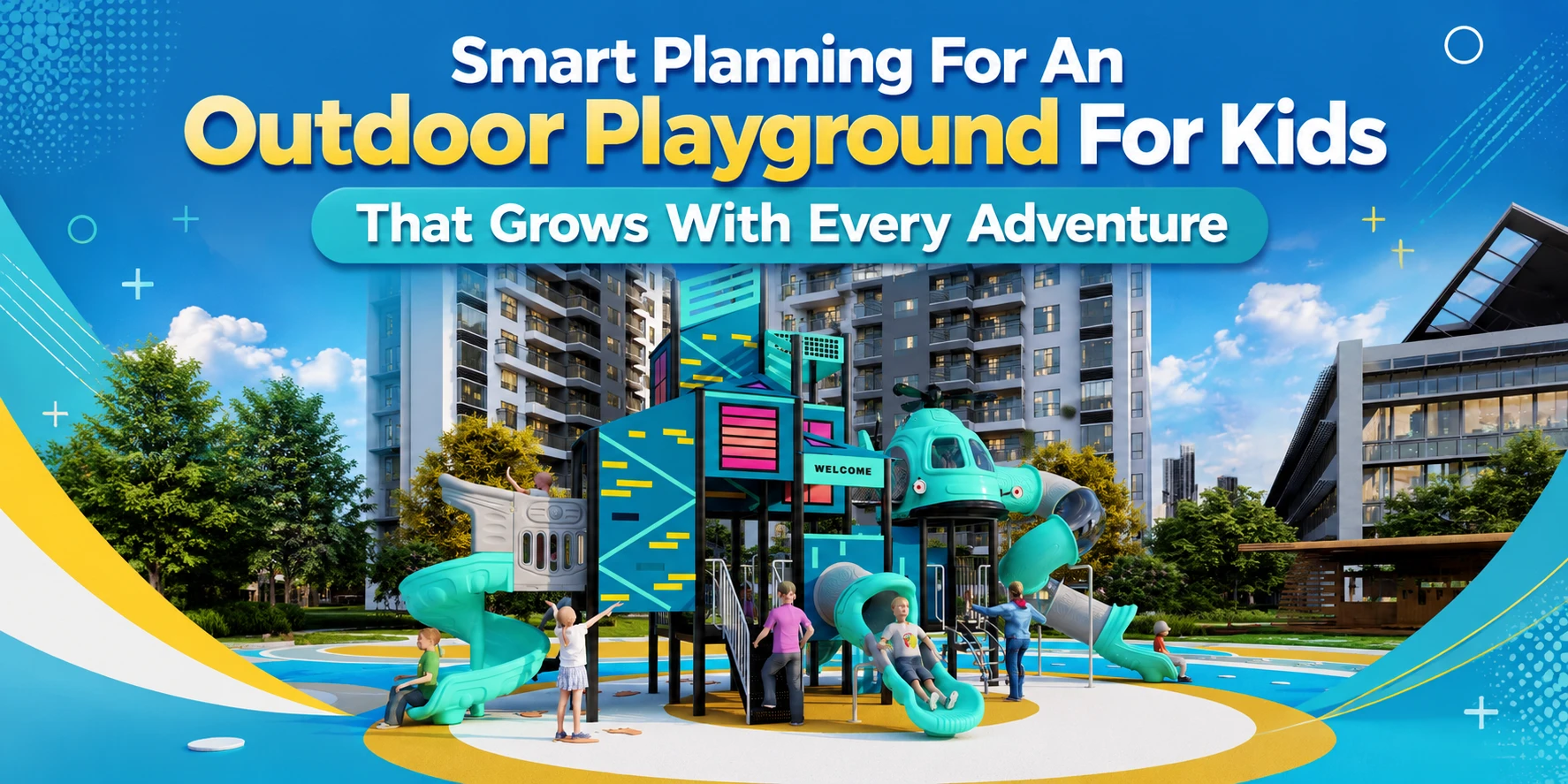
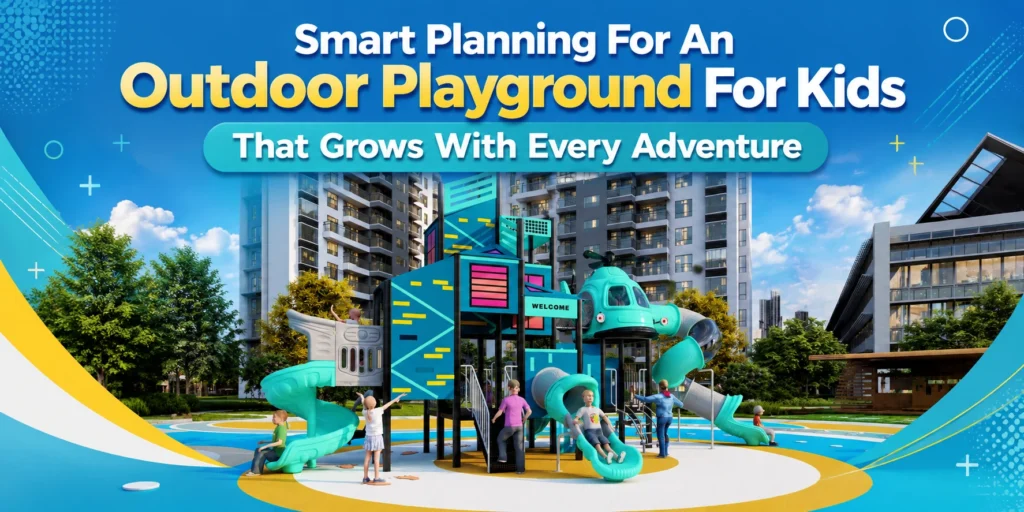
Planning an outdoor playground for kids involves far more than picking a slide and some swings. For municipal buyers, school districts, and commercial developers, the challenge lies in balancing engaging play value with rigorous safety standards and a defined budget. A poorly planned zone can lead to compliance fines, higher insurance premiums, or childhood injuries.
An outdoor playground for kids is a permanently installed play area designed for public or commercial use. It typically includes structures such as climbing frames, spinners, and slides, grouped by age appropriateness, with impact-absorbing surfacing beneath. The CPSC Public Playground Safety Handbook and ASTM F1487 guide critical decisions on fall height, equipment spacing, and maintenance schedules.
Effective playground project planning demands a structured process: define age zones, choose compliant surfacing, allocate budget across equipment and installation, and prepare the site for drainage and accessibility.
For over 30 years, JQ Playground (Wenzhou Jiqi Amusement Equipment Co., Ltd.) has been a trusted manufacturer of outdoor playground equipment, offering free CAD design, OEM/ODM services, and comprehensive after-sales support. This guide serves as a practical playground project guide for procurement teams and project leads navigating specification, tendering, and installation.
Types of Outdoor Playground Equipment for Age-Appropriate Zones
Age zoning is the single most effective way to reduce injuries and maximise developmental value in an outdoor playground for kids. The Consumer Product Safety Commission (CPSC) recommends separating play areas by age because children’s motor skills, risk perception, and physical size differ radically between 2–5 and 5–12 years old. JQ Playground offers a wide range of age-appropriate equipment, from toddler bucket swings to multi-level play structures, all designed to meet ASTM and EN1176 standards.
Equipment for toddlers (2–5 years)
Young children need low-height, sensory-rich activities that build balance and coordination.
– Low platforms and ramps – maximum platform height typically 1 metre.
– Small slides – wave or straight slides, maximum 1.5 m high.
– Bucket swings – enclosed seats; swing bay spacing at least 1.8 m apart.
– Spinners and sensory panels – ground-level merry-go-rounds, gear boards, textured panels.
– Spring riders – animal-shaped rockers under 1 m height.
Equipment for school-age children (5–12 years)
Older children seek speed, height, and social play.
– Overhead climbers – horizontal ladders, ring trails, net climbers; critical fall height up to 2.5 m.
– Tube slides and spiral slides – heights up to 3 m with clear landing area.
– Belt swings and tire swings – swing bay width 2.7 m per bay.
– Multi-level play structures – composite units with platforms, tunnels, bridges.
– Track rides and zip lines – require 2.5 m fall zone and deceleration area.
Separate zones physically with a 2 m buffer to prevent collisions. This layout simplifies playground site planning and reduces surfacing material waste.
Safety Surfacing and Compliance Standards: Poured Rubber, Rubber Tiles, Engineered Wood Fiber
The surfacing you choose determines safety rating, maintenance schedule, and total project cost. Three options dominate commercial playgrounds: poured rubber, rubber tiles, and engineered wood fiber. Each meets ASTM F1292 when installed correctly for the equipment’s critical fall height. JQ Playground’s equipment is tested to withstand critical fall heights specified by ASTM F1292 and EN1176, ensuring compatibility with any surfacing choice.
Poured rubber – seamless, ADA-compliant, £40–£70 per m² installed. Low maintenance, but professional installation required and colour matching on repairs is difficult.
Rubber tiles – modular, £25–£45 per m² for materials. Easier installation, individual tile replacement, but joints can separate over time.
Engineered wood fiber (EWF) – budget-friendly at £15–£25 per m² installed. Needs 225 mm depth for 3 m fall height, requires quarterly topping up, not wheelchair friendly without firm pathways.
| Surface type | Cost per m² (installed) | Critical fall height (typical) | Maintenance load |
|---|---|---|---|
| Poured rubber | £40–£70 | Up to 3 m at 50 mm depth | Low |
| Rubber tiles | £25–£45 | Up to 2.4 m at 50 mm depth | Medium |
| EWF | £15–£25 | Up to 3 m at 225 mm depth | High |
All options must comply with ASTM F1292 and EN1176. Include surfacing compliance in your playground RFQ checklist and verify test reports before installation.
Budget Planning and Procurement Timeline for Outdoor Playground Projects
A typical playground project allocates funds: equipment (40–50%), safety surfacing (20–30%), installation (15–20%), and site preparation (10–15%). Your playground safety surfacing plan often determines the largest variable cost.
Procurement sequence:
1. RFQ preparation and vendor selection – specify equipment types, fall heights, surfacing material. Request compliance certifications. JQ Playground can provide detailed RFQ specifications and free design support.
2. Permitting and site preparation – obtain approvals while clearing, grading, installing drainage.
3. Installation – equipment assembly, anchoring, surface installation.
4. Inspection and sign-off – verify fall height compliance, accessible routes, fastener security.
From RFQ to completion, plan for three to six months. Tightening the budget breakdown early keeps the timeline realistic.
Essential Site Considerations for Commercial Playground Installations
Site preparation determines long-term safety and maintenance. Evaluate these factors before ordering structures:
– Drainage: Ensure 1–2% grade away from structures; gravel base beneath safety surface for clay-heavy soil.
– Sun exposure: Place tall equipment on south/west side; avoid direct north-south slide orientation.
– Accessibility (ADA): Firm, stable transfer surfaces; 1:12 slope ramp for platforms above 300 mm.
– Proximity to amenities: Playground within 30 m of restrooms, 15 m of drinking fountain; shade over at least 40% of equipment footprint.
– Fall zone clearance: 1.8 m clearance around stationary equipment, 2.4 m behind swing seats; 1.8 m buffer from traffic.
Mapping these conditions early prevents expensive retrofits. JQ Playground offers trial installation before shipping and can send engineers to your country for assembly assistance.
Project Support from JQ Playground for Your Outdoor Playground
JQ Playground (Wenzhou Jiqi Amusement Equipment Co., Ltd.) provides end-to-end support for commercial playground projects. With a 60,000 sqm production base, 20+ production lines, and 180 skilled workers, the company manufactures high-quality equipment under strict quality control. Key services include:
– Free CAD-based playground design tailored to your site.
– OEM/ODM capability with 100+ patents and constant R&D.
– Trial installation before shipping to verify assembly and safety.
– One-year warranty and free replacement of defective parts.
– Export to over 2,000 containers annually, with certifications including ISO, BSCI, EN1176, EN71, ASTM, CPC, and CPSIC.
For project leads, JQ Playground streamlines the journey from site idea to RFQ and installation handoff, ensuring a safe, durable, and engaging outdoor playground for kids.
About JQ Playground – playgroundprojectguide.com
JQ Playground (Wenzhou Jiqi Amusement Equipment Co., Ltd.) is a children’s playground equipment manufacturer founded in 1993. The company provides design, customization, large-scale manufacturing, sales, installation guidance, and after-sales support for outdoor playgrounds, indoor playgrounds, soft play, water playgrounds, PE board playgrounds, kindergarten furniture, outdoor fitness equipment, pet playgrounds, and playground facilities. Approved company facts include 180+ employees, a large Wenzhou production base, 20+ production lines, 55 production machines, ISO/BSCI/EN1176/EN71/ASTM/CPC/CPSIC certification references, 100+ patents, free design support, OEM/ODM capability, trial installation before shipping, export experience, and one-year quality warranty.