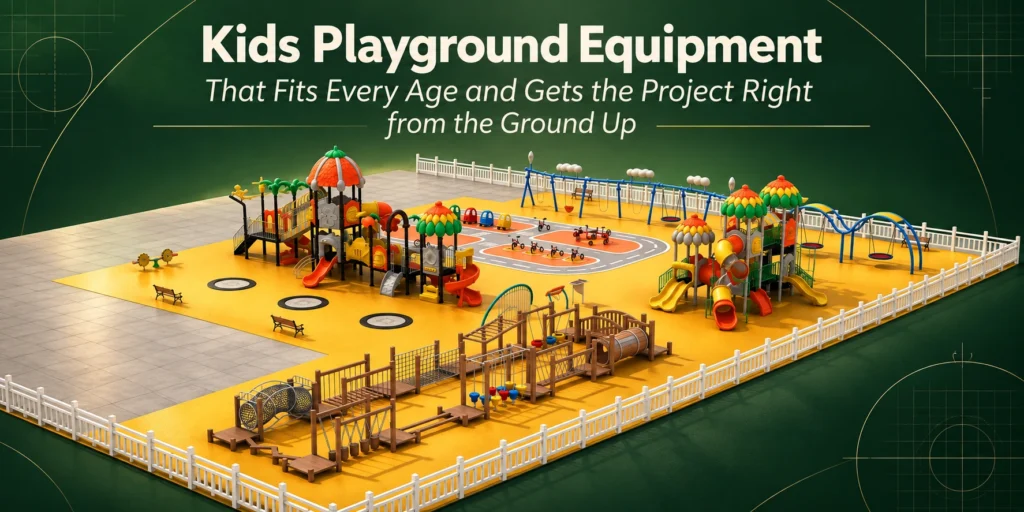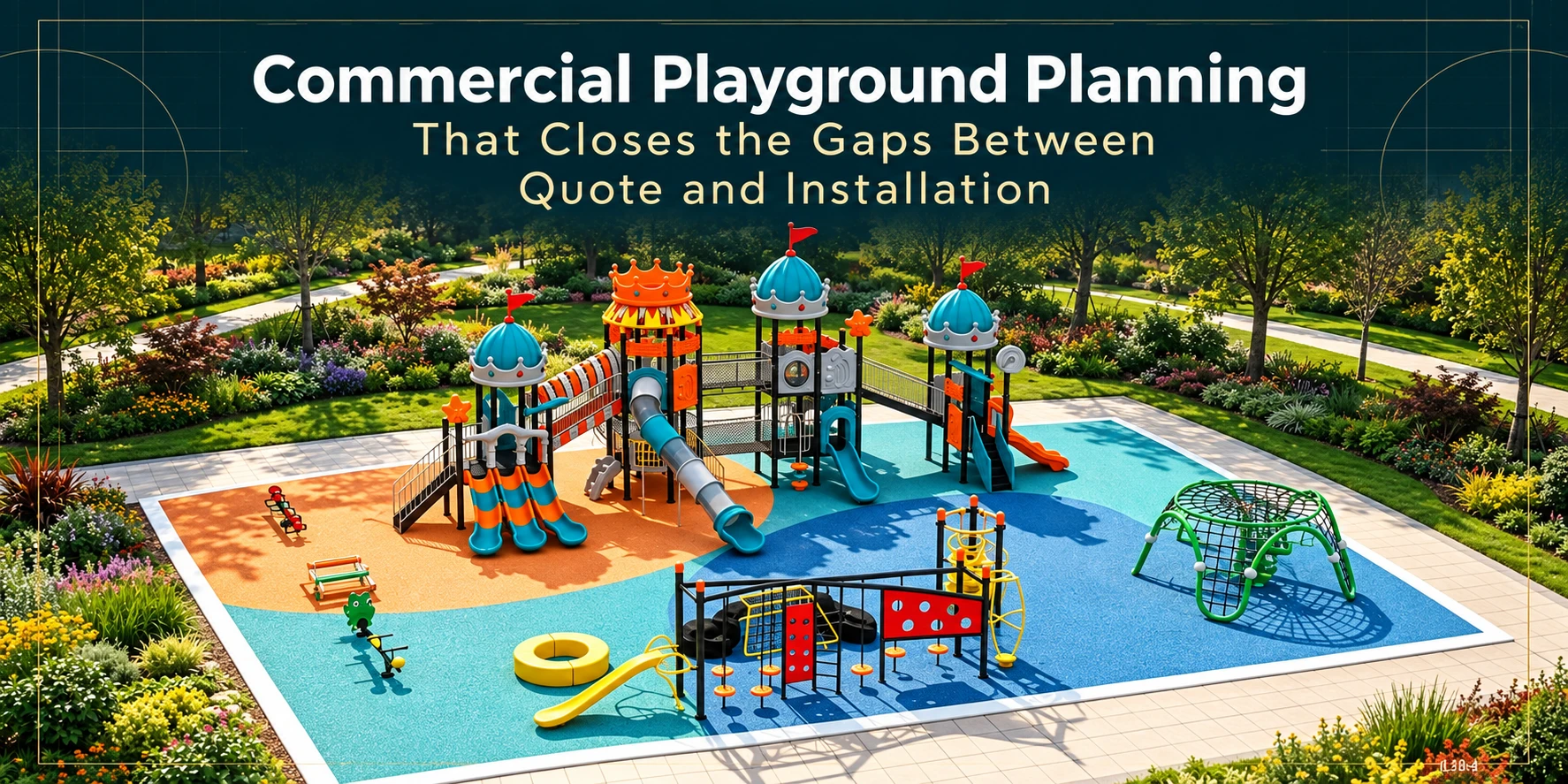
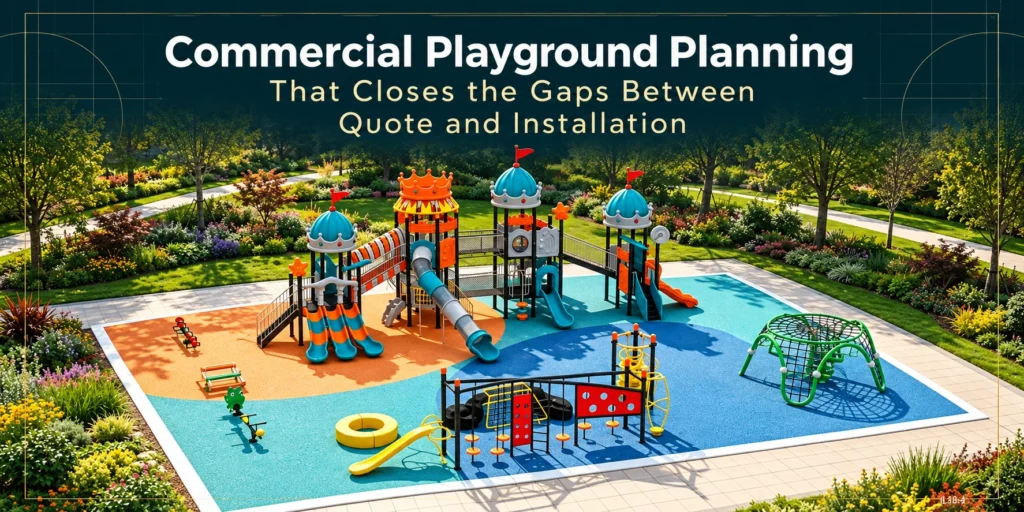
Ordering a commercial playground without a fixed brief usually costs more than it saves. A vague specification can push delivery past a school holiday window, or leave a site with equipment that installers cannot fix safely. Most of these problems trace back to one gap: no agreed playground project planning checklist before the request for quotation.
A commercial playground is a public or semi-public play area built from heavy-duty structures — slides, swings, climbing frames, multi-play towers, and safety surfacing — designed for continuous use by many children and specified, installed, and maintained to recognised safety standards. Unlike residential play sets, commercial playground equipment is engineered for higher load cycles, documented inspection records, and age-banded safety requirements across schools, parks, housing developments, and resorts.
This playground project guide covers specification, component choice, applications, custom manufacturing, and supplier comparison.
How Commercial Playground Works
A commercial playground works as an engineered system, not a set of separate items. Each stage below maps to a buyer check you can verify before ordering.
- Site survey and layout. You confirm ground conditions, fall height and use zone before layout. Demand dimensioned drawings, not photos alone.
- Post and frame fixing. Posts are anchored to concrete footings, ground sockets or surface mounts. Check footing depth against the layout plan.
- Deck, access and enclosure. Platforms, steps, ramps and barriers define the play route. Confirm age-group sizing against your brief.
- Play events and surfacing. Slides, climbers and swings are fitted, then impact-absorbing surfacing is installed to the tested fall height.
Component roles
Structural posts carry load. Decks and guardrails control access. Slides, climbers and swings deliver the play value. Fixings and surfacing govern how repeatably a batch performs after installation.
Buyers who approve a layout without a fall-height and footing check usually pay for remedial groundworks later.
Playground site planning should start with these four stages, so the specification below can be read against your own site data.
Commercial Playground Components and Product Types
| Product type | Typical use | Check before RFQ |
|---|---|---|
| Swing sets | 2–12 age zones | Bay spacing, seat type, frame length |
| Slide units | Free-standing or linked decks | Deck height, slide length, exit run-out |
| Climbing frames | Balance and upper-body play | Cradle grip diameter, max fall height |
| Multi-play units | Compact sites, high capacity | Footprint, capacity per module |
| Safety surfacing | Under all equipment | Critical fall height, depth per material |
- Post specification: 89–114 mm steel or 100 mm timber posts; wall thickness drives bay spacing.
- Age band: 2–5, 5–12 or combined — this sets fall height, capacity and supervision needs.
- Connectors and fixings: clamp type, bolt grade, ground anchors, and whether posts are in-ground or surface-fixed.
- Capacity: users per module, so a site brief can be sized before layout.
A written playground RFQ checklist keeps these comparable across suppliers, and the same data feeds a later playground installation checklist once equipment is confirmed. These categories then map onto different site types.
Typical Applications for Commercial Playground
Those product categories serve distinct site types. Use them to shape your specification.
Municipal parks: Choose multi-age modular units with anti-climb barriers. Confirm fixing compatibility with existing concrete footings. Schools: Prioritise inclusive play panels and durable steel posts. A school playground project planning check should match batch quantities to pupil numbers. Resorts and communities: Specify themed towers and shade sails. Verify connector corrosion resistance for coastal or humid sites.
| Factor | Buyer action |
|---|---|
| Age group | Match deck height and slide type |
| Surface | Align with playground safety surfacing plan |
| Batch demand | Confirm repeatable component counts |
| Quality evidence | Request weld and coating inspection records |
These scenarios also determine what can be customised, which the next section covers.
Custom Commercial Playground Manufacturing and OEM Cooperation
Custom work starts with what you already have: CAD drawings (DWG, STEP or PDF), a site plan, or a physical sample such as a post cap, clamp or deck fitting. The route is fixed — drawing review, written quote, sample confirmation, packaging approval, batch inspection, shipment. Production does not start until you sign off the sample, which is where playground budget planning usually tightens, because tooling cost and packed volume move the unit price more than the play structure itself.
| Stage | Your input | Manufacturer output |
|---|---|---|
| 1. Brief | Drawings, sample, colour reference (RAL or Pantone), target quantity | Feasibility notes listing open questions and material options |
| 2. Quote | Confirmed dimensions, finish, packing style | Itemised quote covering unit price, tooling, lead time, payment terms |
| 3. Sample | Approval, or revisions marked on the drawing | One pre-production sample for fit, colour and load check |
| 4. Packaging | Logo position, carton spec, pallet layout | Packing drawing plus a photo of the first packed carton |
| 5. Inspection | AQL level and the checkpoints you want recorded | Batch report with measurements, weld and coating photos |
| 6. Shipment | Consignee, shipping marks, document list | Loading photos, packing list, container seal number |
What Batch Inspection Should Record
Dimensional checks against the approved drawing, hardware pull-out results, coating thickness readings, and a photo of every pallet before the container doors close.
Supplier depth and shortlisting criteria follow.
Top 10 Commercial Playground Manufacturers and Supplier Fit
A commercial playground shortlist rarely fails on play value. It fails on supply fit. Group candidates by supply model first, then compare four or five names inside the one that matches your programme.
| Supplier type | Pros | Cons | Best fit |
|---|---|---|---|
| European premium timber-and-steel ranges | Deep design library, published load data, long service life | High unit cost, long freight windows, rigid catalogue | Signature parks, resorts and schools with fixed design intent |
| North American turnkey design-build firms | One contract for design, install and surfacing | Mobilisation costs, limited spare-part flexibility | Municipal and campus projects wanting a single accountable party |
| High-volume imported steel and HDPE systems | Competitive unit pricing, fast reorder on standard modules | Custom colours stretch lead times, packing damage risk rises | Roll-outs, community parks, batches above ten units |
| Regional steel fabricators | Short freight, quick on-site fixes, bespoke frames | Thinner catalogue, less documented evidence | Tight sites, repairs and extensions |
| OEM/ODM contract manufacturers | Range can be badged, mixed and packed to your spec | Tooling and sample cycles add weeks before batch one | Own-brand ranges and multi-year programmes |
Score each candidate against:
- Playground age zone layout: does the range cover 2–5, 5–12 and teen zones, or only one band?
- Playground closeout documents: as-built drawings, maintenance schedule and inspection records in one pack?
- Spares: named components with a stated reorder window, not whole-unit replacement.
- Repeatability: identical colour, hardware and fittings on the second and third order.
Buy on the supply model first and the catalogue second; the wrong model costs more than the wrong slide.
Terms, verification steps and handover requirements follow.