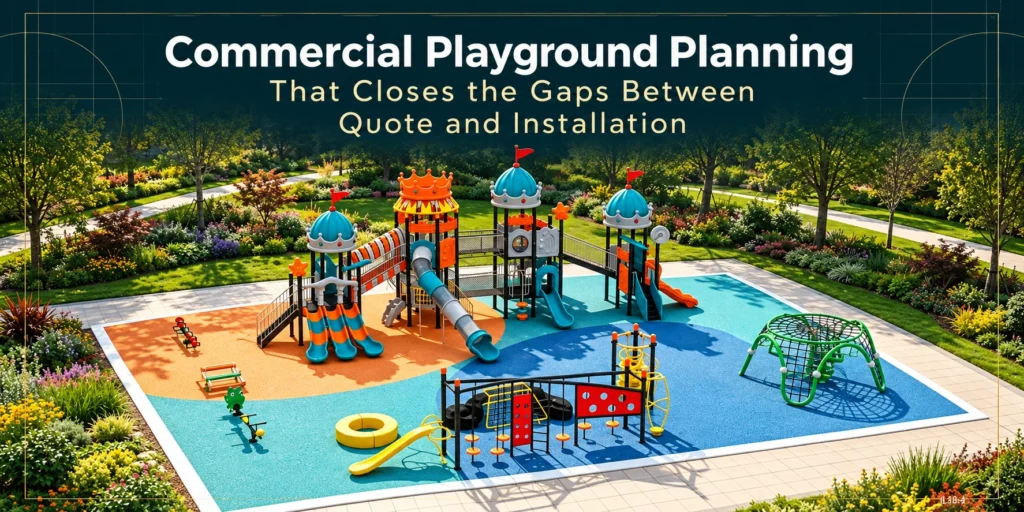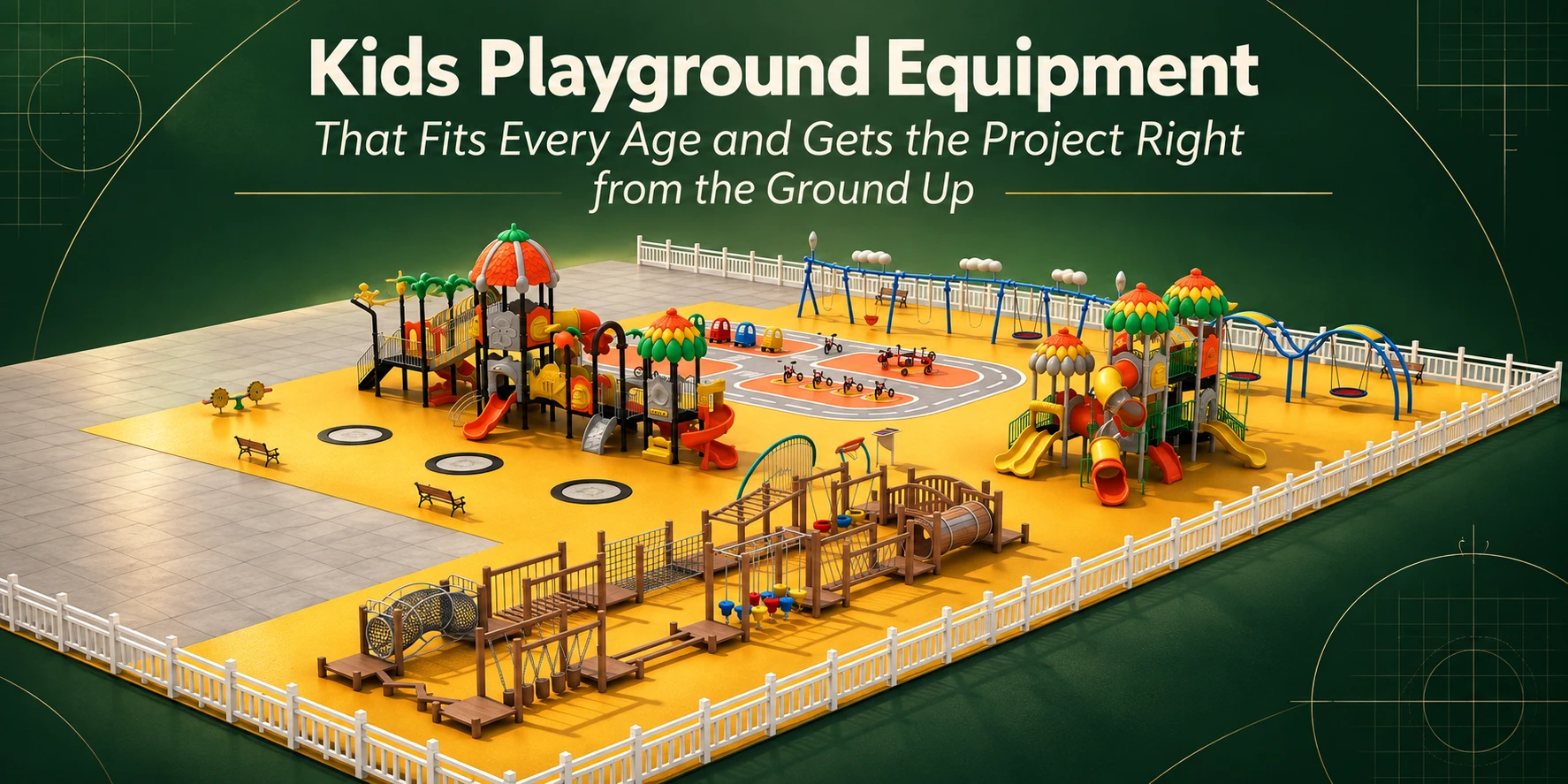
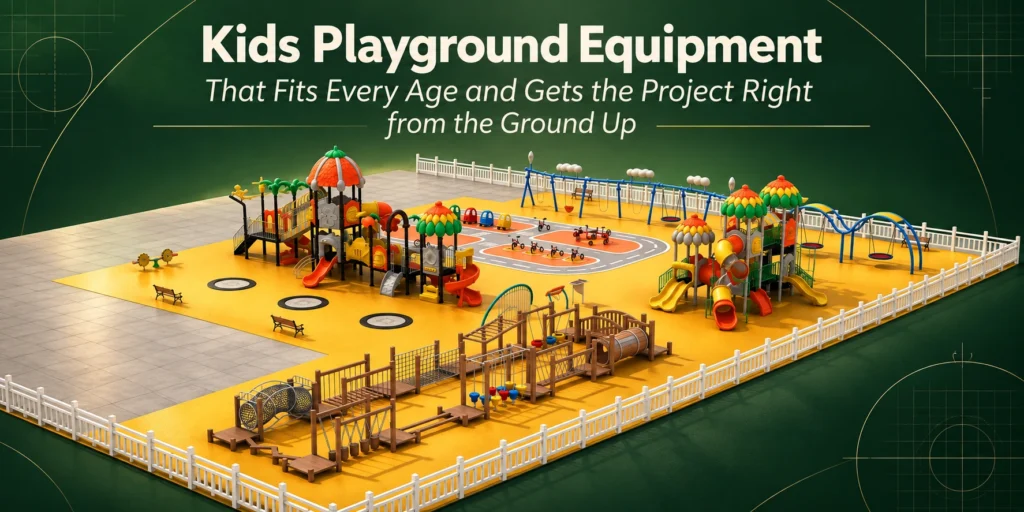
Matching one structure to ages 2 to 5 and 5 to 12 rarely satisfies either group. Toddler decks sit too low for older children, while upper platforms can exceed the fall height your safety surface is designed to absorb. The result is rework, wasted surfacing budget, and openings pushed back by weeks. Settling age band, user capacity, and fall height early is the core of sensible playground project planning.
Kids playground equipment covers the manufactured structures children use to climb, slide, swing, and balance — including posts, decks, slides, climbers, swing bays, and spring rockers. Buyers sort it by age band, usually 2–5 or 5–12; by play type, such as physical, sensory, or social; and by mounting method, whether free-standing, in-ground, or surface-anchored.
The sections below explain how these systems are specified — a practical playground project guide for your site.
How Kids Playground Equipment Works
Playground equipment works as a load path: movement from slides, swings, and climbing frames passes through decks and posts into footings, while the surface absorbs impact energy.
- Define users and site — age band (2–5 or 5–12), capacity, and fall height.
- Specify the structure — post diameter, deck size, clamps, and stainless fixings for the layout.
- Match the surface — depth and material follow measured critical fall height.
- Install and verify — footing depth, torque values, and entrapment gaps get recorded.
- Inspect on a cycle — written checks keep performance repeatable.
For your playground site planning, compare suppliers on one layout: matching part counts and fall-height data signal repeatable production.
Component roles
Posts carry vertical load, typically galvanised steel with powder coating. Decks, clamps, and hangers transfer dynamic load, so wall thickness and fixing grade are key checks.
Confirm age-band and fall-height data before approving any unit.
Component options and product types come next.
Kids Playground Equipment Components and Product Types
Buyers compare five core categories before releasing a playground RFQ checklist; age band and fall height decide the rest.
| Product type | Components to compare | Key specification |
|---|---|---|
| Multi-play post-and-platform units | Steel posts, decks, roofs, panels | Post wall thickness, deck height |
| Swing sets | A-frame or single pole, top rail, chains, seats | Seat type (bucket, cradle, flat) |
| Slide units | Bedway, side rails, entry platform | Run-off length behind the chute |
| Climbing frames and boulder walls | Holds, nets, ladders, grip surfaces | Hold spacing, fall-height rating |
| Spring rockers and see-saws | Spring base, handles, footrests, frame | Spring rating, footing depth |
- Post material: galvanised steel at 2.0–3.0 mm wall, or powder-coated aluminium.
- Fasteners: tamper-resistant bolts with capped ends; no exposed threads at hand height.
- Footings: surface-mount base plates or in-ground concrete, chosen by soil and drainage.
- Plastic parts: HDPE with UV stabiliser, checked against a playground installation checklist.
Age band, capacity and site footprint then narrow the choice.
Typical Applications for Kids Playground Equipment
Application type decides the build. Match each setting to the right product before you compare quotes.
- Municipal parks: high-traffic post-and-deck units with steel posts, 3.5–4 m platforms and modular climbing panels. Batch demand runs 5–20 units per phase; ask for salt-spray results and load-test records.
- Schools: age-split zones with 1.2–1.5 m decks for ages 3–5 and 1.8–2.2 m for ages 6–12. Request a school playground project planning pack covering fall-height zones and inspection intervals.
- Resorts and communities: themed towers with slide connectors, rope nets and shade canopies. Confirm stainless fixings and UV-stable colour options for coastal sites.
- Indoor play centres: soft-play frames, padded posts and netted tunnels sized to ceiling height.
| Factor | Buyer action |
|---|---|
| Site footprint | Confirm deck count and safety-zone radius |
| Use intensity | Specify post wall thickness and bearing plates |
| Surfacing | Align the playground safety surfacing plan to equipment fall height |
Next, see how drawings and samples move through custom production.
Custom Kids Playground Equipment Manufacturing and OEM Cooperation
Every custom kids playground equipment order begins with a measurable brief, not a catalogue entry. A drawing, site photo, or physical sample becomes a specification: post diameter, deck height, swing bay spacing, and a colour reference.
| Stage | You provide | Manufacturer returns |
|---|---|---|
| Brief | Drawing, sample unit, age group, site dimensions | Spec sheet with post gauge, deck height, component list |
| Quote | Target quantity, finish and colour codes, packaging style | Unit price, tooling cost for new parts, lead time |
| Sample | Written sign-off on colour and hardware | One pre-production sample for fit and finish |
| Packaging | Carton or pallet preference, logo placement | Labelled cartons, hardware bagged per play bay |
| Batch check | Inspection list and acceptance level | Dimensional and load-check records per batch |
| Shipment | Delivery window, destination port | Container loading plan and shipping documents |
Playground budget planning firms up once the sample is approved, because tooling and packaging choices settle at that point. How consistently these six stages repeat is what separates suppliers — the next section compares manufacturer types.
Top 10 Kids Playground Equipment Manufacturers and Supplier Fit
Supplier fit decides your compliance pack and lead time more than catalogue size does. Four supplier types cover most playground tenders.
| Supplier type | Pros | Cons | Best fit |
|---|---|---|---|
| Large commercial play systems manufacturers | Full age range, EN 1176 test packs, spare parts catalogue | Higher unit cost, 12–16 week lead times | Municipal parks, school tenders |
| Timber and natural play specialists | Low-carbon materials, bespoke shapes, sculpted climbing | Annual rot treatment, weather-dependent installs | Resorts, eco-site and heritage projects |
| Regional steel fabricators | Short lead times, bespoke dimensions, local delivery | Narrow age-zone ranges, thinner documentation | Community retrofit, contractor packages |
| Modular plastic and water-play suppliers | Fast assembly, low maintenance, replaceable modules | Single age band, UV and heat limits in hot climates | Holiday parks, community operators |
Score each candidate before requesting samples:
- Coverage — does one range span every age zone in your playground age zone layout?
- Evidence — are EN 1176 test reports and playground closeout documents issued per batch?
- Repeatability — did the last three projects ship on the promised date?
- Support — are samples, spare parts, and custom colour options confirmed in writing?
Shortlist supplier types before comparing prices; the type decides which documents you receive at handover.