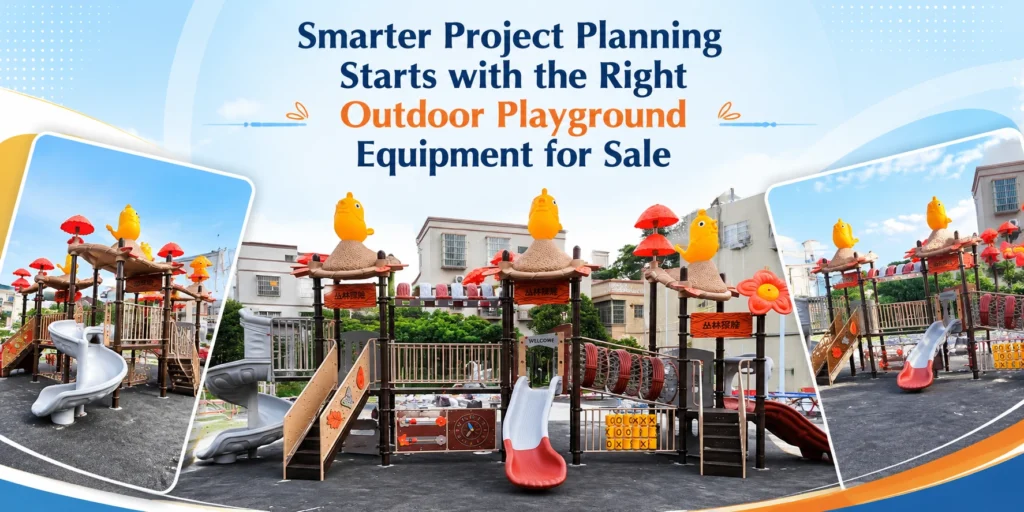
You’ve secured budget for a new community playground. But choosing the wrong equipment means costly retrofits, safety failures, or underused spaces.
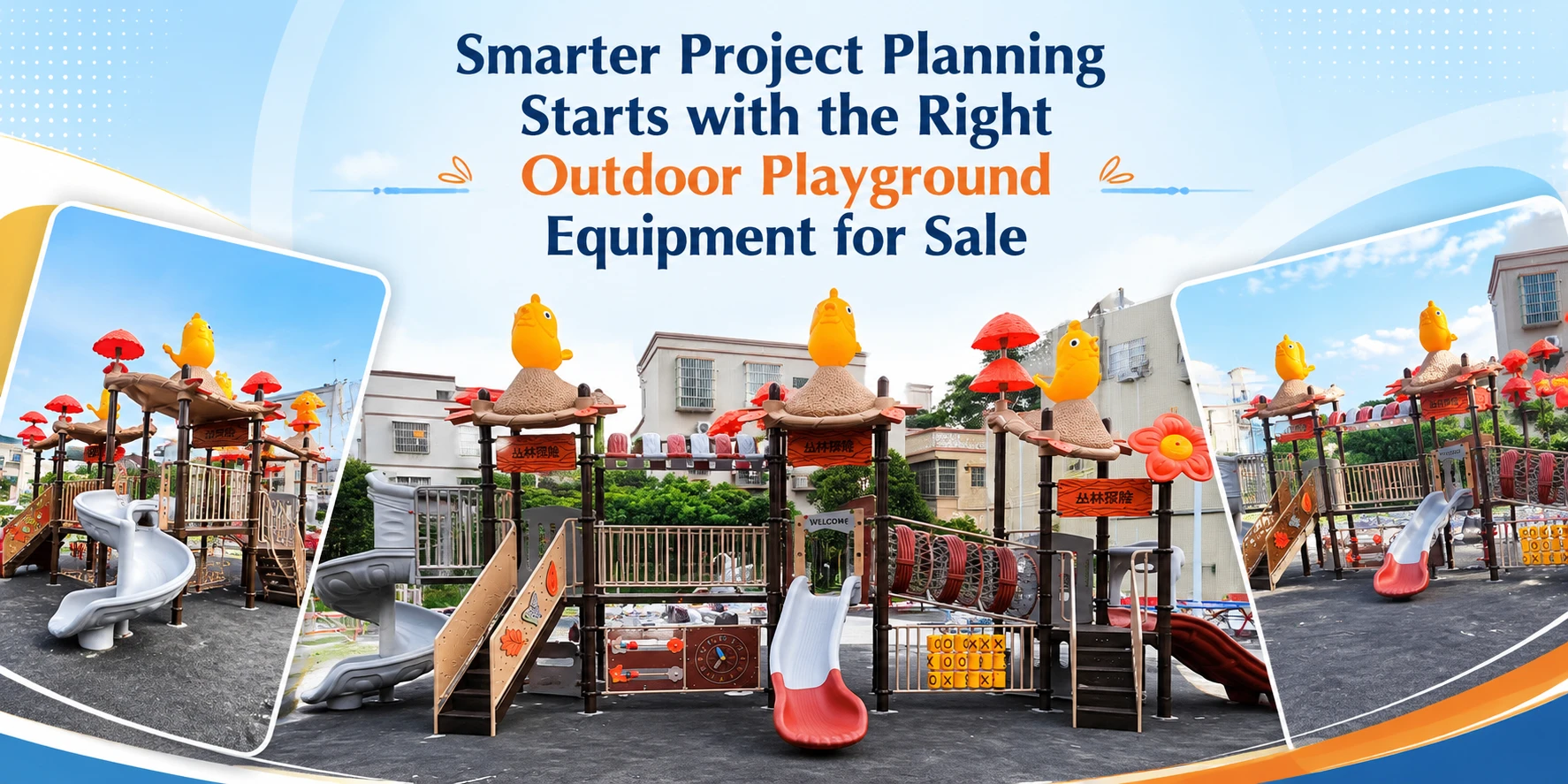
Outdoor playground equipment for sale refers to commercial-grade products designed for public spaces — schools, municipal parks, resorts, and housing developments. Unlike residential sets, they must withstand daily use, meet strict safety standards, and serve inclusive age ranges.
Getting the specification right early in your playground project planning prevents redesigns and delays. This playground project guide helps you evaluate types, certifications, and suppliers before you issue an RFQ.
Types of Outdoor Playground Equipment Available for Commercial Projects
A well-rounded playground needs equipment that serves different age groups and play types. Your commercial playground planning guide should cover these core categories. Each type uses specific materials and requires a certain footprint. Below are the main options for parks, schools, and resorts.
Modular play structures
These are the centerpiece of most projects. They combine platforms, slides, tunnels, and activity panels. Materials are typically galvanized steel frames with HDPE plastic decks and panels. Designed for ages 2–5 or 5–12. Space requirement: minimum 1,200 sq ft for a small unit, up to 3,000 sq ft for larger combinations. Example: a resort water-play hybrid with shaded roof panels and themed panels.
Swings
Standard belt swings for ages 2–12, bucket swings for toddlers, and inclusive accessible swings with harnesses. Frames are powder-coated steel or recycled plastic. Each swing bay needs about 3 ft wide by 12 ft deep of fall zone. Schools often use three-bay swing sets to accommodate queues at recess.
Slides
Available as straight, wavy, or spiral tubes. Materials: rotationally moulded HDPE or stainless steel. Age range 2–12; height from 4 ft to 12 ft. A straight slide needs an 8 ft clearance at the exit and a fall height equal to the platform height. Resorts often use tall spiral slides as visual landmarks.
Climbers
Net climbers, arch climbers, rock walls, and horizontal ladders. Frames are aluminium or galvanised steel; climbing surfaces use rubber holds or nylon nets. Ages 5–12 require higher challenge levels. Footprint varies from 8 ft x 8 ft for a simple arch to 20 ft x 20 ft for a multi-element climbing web. Community parks use climbers to meet intensity ratings for older children.
Spinners
Rotating equipment like bowl spinners, merry-go-rounds, and disc spinners. Low height (under 24 inches) for ages 2–5; higher models for 5–12. Material: metal base with rubber or HDPE seat. Requires a 10 ft diameter clear zone. Popular in inclusive playgrounds where wheelchair users can roll onto bowl spinners.
Safety surfacing
Not technically play equipment, but essential for compliance. Poured-in-place rubber, rubber tiles, or engineered wood fibre. Minimum fall height coverage depends on equipment height (e.g., ASTM F1292 requires 9 inches of wood fibre for a 6 ft fall height). All commercial projects need surfacing that meets EN1176 or ASTM standards. A school playground typically budgets 30–40% of total cost for surfacing.
Choosing the right mix depends on your site plan and user age groups. Playground site planning should allocate at least 3 ft of clearance around every component for safe circulation.
Key Safety Standards and Certifications for Playground Equipment
Once the equipment types are selected, verifying that each component meets recognised safety standards protects both users and your organisation’s public liability coverage. Commercial playground equipment should comply with ASTM F1487 (North America) or EN1176 (Europe) – the two dominant benchmarks for public-play safety. Without these certifications, insurance policies may refuse claims arising from injury incidents.
| Standard | Region | Key Scope |
|---|---|---|
| ASTM F1487 | United States & Canada | Covers equipment for children aged 2–12 in parks, schools, and public spaces; defines use zones, fall heights up to 12 ft, and entrapment avoidance. |
| EN1176 | Europe & many export markets | Applies to children 0–14 years; specifies critical fall heights (e.g., 3 m for swings), head/neck entrapment tests, and impact-absorbing surfacing requirements. |
Both standards require that openings between 230 mm and 660 mm be probed to prevent entrapment, and that surfacing materials match the equipment’s critical fall height. For example, a slide with a 2.5 m platform must sit on 300 mm of loose-fill material certified to EN1177.
Request these documents from every supplier before finalising an order:
- Current EN1176 or ASTM F1487 test certificate from an accredited lab
- Third-party test reports covering fall height, entrapment, and structural load
- A supplier’s playground RFQ checklist confirming all compliance documentation is included
- An installation checklist that matches the certified design, ensuring safety features are assembled correctly
How to Evaluate and Compare Playground Equipment Suppliers
Once your compliance documents are in order, the real supplier comparison starts. Focus on these five criteria when reviewing proposals:
- Certifications – Confirm current ASTM F1487 or EN1176 certificates from an accredited lab for the exact equipment model. Certificates older than five years may not cover design updates.
- Warranty terms – Structural components (steel frames, HDPE panels) typically carry 10–15 years; moving parts (bearings, chains) 1–5 years. Ask for exclusions on vandalism or improper installation.
- Installation support – Does the supplier offer on‑site supervision, or only a manual? For modular structures, certified installer training prevents costly rework and ensures compliance with your playground safety surfacing plan.
- Customisation options – Colour, theme, add‑on components, and signage. Some suppliers limit custom orders to minimum quantities; others allow flexible design for school playground project planning.
- Minimum order quantity (MOQ) – Varies by product line. Small school projects may need suppliers with MOQs of one unit; community parks often benefit from bulk pricing on multiple structures.
When comparing RFQ responses, look beyond price. A supplier that provides detailed lead times (typical 6–12 weeks for custom orders) and shipping options (container vs LTL for bulk equipment) signals reliable project planning. Vague responses on delivery schedules often mean scheduling risks. For large orders, ask about partial shipping to align with site readiness.
Supplier example: JQ Playground
Founded in 1993, JQ Playground (Wenzhou Jiqi Amusement Equipment Co., Ltd.) is a manufacturer with over 30 years of experience producing outdoor playground equipment for sale. The company holds certifications including EN1176 and ASTM standards, supported by 100+ patents. With a 60,000 sqm production base and 20+ production lines, JQ Playground can deliver a 40HQ container within 3 days on priority orders. Their free design service includes CAD-based playground planning, and trial installation before shipping ensures fit. A 1-year warranty and engineer dispatch for overseas installation support are included. For buyers seeking reliable OEM/ODM partners, JQ Playground offers full customization with a dedicated 8-person design team. Visit playgroundprojectguide.com for more project planning resources.
Budget Planning for Your Playground Project: Cost Factors and Estimates
After evaluating suppliers and confirming lead times, the next step is building a realistic budget. Playground project costs vary widely depending on equipment size, materials, site conditions, and installation requirements. Understanding the major cost drivers helps you allocate funds accurately and avoid surprises.
Key cost factors to account for:
- Equipment size and complexity – A basic play structure for a small school may cost $15,000–$50,000, while a large multi-tower system for a resort can exceed $200,000.
- Material choice – Steel frames with powder coating typically cost 20–40% more than rotomoulded plastic units but last 15–20 years versus 8–12 years for plastic.
- Customisation – Branded colours, themed panels, or bespoke layouts add 10–25% to equipment cost.
- Site preparation and ground works – Clearing, levelling, drainage, and footings can run $5,000–$30,000 depending on soil condition and tree removal.
- Safety surfacing – Rubber wet-pour or tiles cost $10–$18 per square foot installed; engineered wood fibre is $4–$8 per square foot. Surfacing often represents 30–50% of total project spend.
- Installation – Professional assembly and anchoring typically adds 20–30% of equipment cost.
- Shipping and logistics – Freight for a container load from a domestic manufacturer runs $2,000–$8,000; customs and duties apply for imported equipment.
For typical project scales, estimate small school playgrounds at $25,000–$60,000, medium community parks at $60,000–$180,000, and large resort or destination playgrounds at $200,000–$500,000 or more. Factor in a 10–15% contingency for unforeseen ground conditions or late-stage design changes. Use this playground budget planning framework to align your scope with available funding before sending out RFQs.
About JQ Playground – playgroundprojectguide.com
JQ Playground (Wenzhou Jiqi Amusement Equipment Co., Ltd.) is a children’s playground equipment manufacturer founded in 1993. The company provides design, customization, large-scale manufacturing, sales, installation guidance, and after-sales support for outdoor playgrounds, indoor playgrounds, soft play, water playgrounds, PE board playgrounds, kindergarten furniture, outdoor fitness equipment, pet playgrounds, and playground facilities. Approved company facts include 180+ employees, a large Wenzhou production base, 20+ production lines, 55 production machines, ISO/BSCI/EN1176/EN71/ASTM/CPC/CPSIC certification references, 100+ patents, free design support, OEM/ODM capability, trial installation before shipping, export experience, and one-year quality warranty.