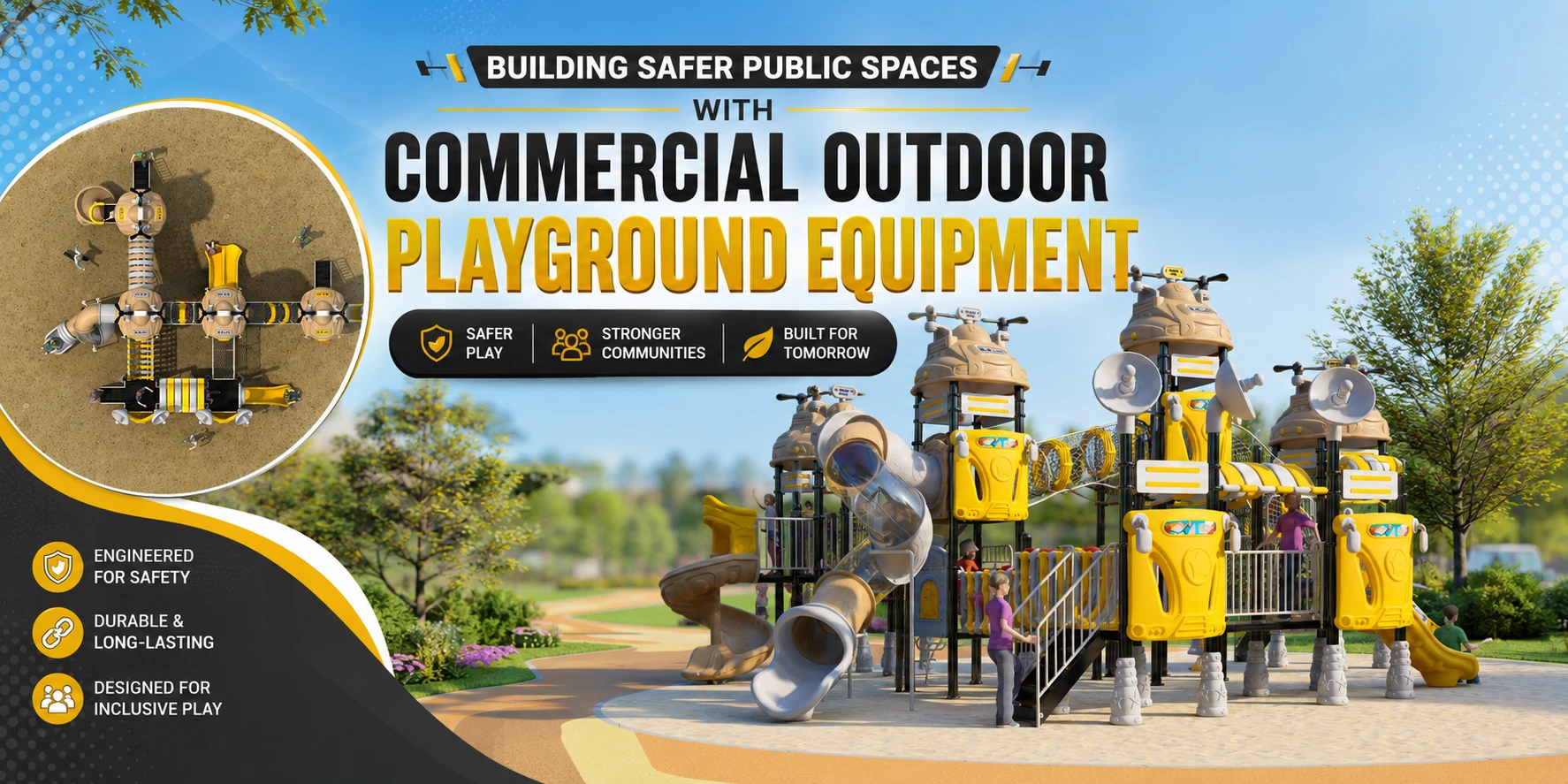
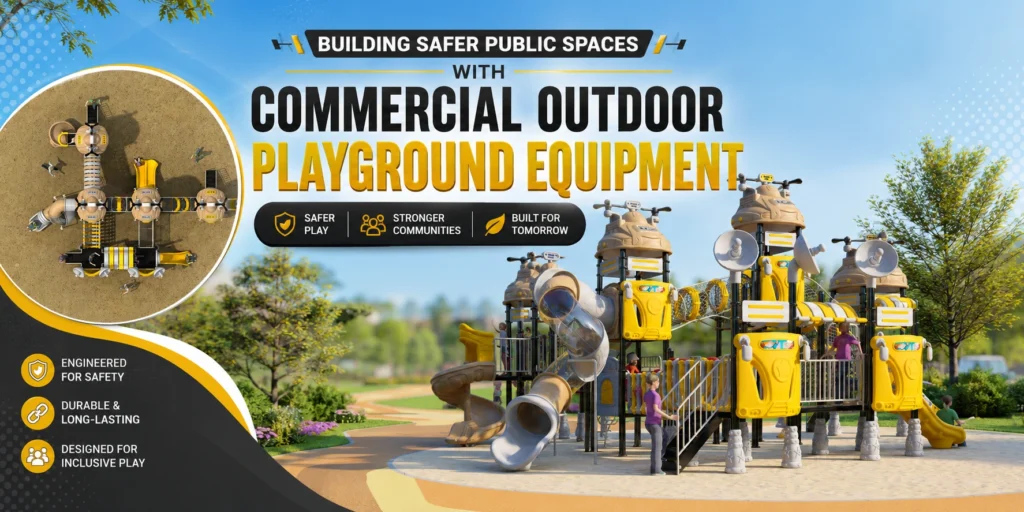
Municipal park planners, school district facilities managers, and resort developers often find it difficult to tell commercial-grade playground equipment apart from residential sets. The two categories look similar in catalogues but differ fundamentally in durability, safety compliance, and intended use. Commercial outdoor playground equipment refers to heavy-duty structures built from materials like galvanised steel and UV-stabilised plastics, designed to withstand daily use in high-traffic public settings. They must meet standards such as ASTM F1487 or EN 1176, with fall-height ratings and surfacing requirements that residential gear does not require. This article serves as a practical playground project guide for procurement teams. It covers key equipment categories, safety standards, project planning from RFQ to installation, and criteria for selecting the right equipment for your site. Whether you are planning a new community park or a school playground, the sections ahead will help you make informed decisions.
What Defines Commercial Outdoor Playground Equipment?
Commercial-grade playground equipment differs from residential sets in three fundamentals: material durability, safety compliance, and structural load capacity. Units use galvanised steel posts (typically 2.875-inch or larger diameter), UV-stabilised HDPE panels, and powder-coated finishes that resist rust, fading, and vandalism over a 10–15 year lifespan. Every component must meet ASTM F1487 (US) or EN 1176 (EU) standards, which govern fall heights, entrapment risks, and impact attenuation.
Residential sets rely on thinner-wall tubing, lighter plastics, and simpler ground anchors. Commercial equipment is designed for continuous daily use by dozens of children, so bearings, chains, and fasteners are industrial-grade and fully replaceable. Warranty periods on commercial gear typically run 10–15 years on structural parts, compared to 1–5 years for residential.
Common types include:
- Swings – belt, bucket, and adaptive tyre seats for inclusive access
- Slides – straight, spiral, and enclosed tube designs with height options up to 2.4 m
- Climbers – cargo nets, arch ladders, rock walls, and curved overhead bars
- Composite structures – multi-level platforms with integrated slides, tunnels, and activity panels
You will find this equipment in public parks, school playgrounds, resort play areas, and daycare centres — anywhere daily traffic exceeds what residential gear can handle. The distinction is critical during playground site planning: commercial equipment demands deeper footings, impact-absorbing surfacing, and documented certification for insurance and grant compliance.
Safety and Compliance Standards for Commercial Playgrounds
The two primary international safety frameworks for commercial playground equipment are ASTM F1487 (United States) and EN 1176 (European Union), with CSA Z614 covering Canada. You must specify one of these standards in your RFQ; insurers and grant bodies typically require documented compliance.
Surfacing absorbs the impact of a fall and is regulated alongside the equipment. Loose-fill materials (wood chips, rubber mulch, pea gravel) must be installed at a depth of at least 9 inches to cushion falls from heights up to 2.4 metres (8 feet). Unitary surfaces (poured-in-place rubber, interlocking tiles) offer consistent shock absorption and can meet fall-height ratings of 1.0–3.0 metres, depending on the product’s ASTM F1292 test report. Your surfacing choice affects cost, maintenance, and accessibility compliance.
Annual comprehensive inspections by a certified playground safety inspector (CPSI or equivalent) are standard, paired with monthly visual checks. For RFI and RFQ submissions, prepare: equipment certification letters, surfacing test reports, and evidence of independent third-party lab testing. Missing these documents can stall procurement.
How to Plan a Commercial Playground Project: From RFQ to Installation
1. Site assessment. Start with soil testing, drainage mapping, accessibility paths, and shade patterns. A playground safety surfacing plan depends on ground conditions—clay soil may need extra drainage, while sandy ground suits loose-fill materials like rubber mulch. Measure fall zones for each piece of equipment against the required surfacing depth (e.g., 150 mm for 2.4 m fall height).
2. Budget allocation. Equipment cost typically accounts for 40–50% of the project total. Surfacing, installation, and shipping each claim 15–25%. Decide early between modular (reconfigurable, quicker delivery) and custom designs (longer lead, higher unit price). Delivery alone can add 2–3 weeks for custom builds.
3. RFQ checklist. Specify required certifications (ASTM F1487 or EN 1176), materials (galvanised steel, HDPE), warranty terms (minimum 10 years on structural parts), and delivery timeline. For a school playground project planning, include accessibility standards (ADA/UK Building Regulations) and preferred surfacing type. Missing any of these delays supplier confirmation.
4. Installation timeline. A typical 10–12 week lead time breaks down as: 2 weeks site prep (clearing, levelling, drainage work), 4–6 weeks equipment fabrication, 1 week delivery, 2 weeks on-site assembly and surfacing, then a final inspection. Schedule the final check at least one week before opening to allow corrections.
Key Criteria for Selecting Commercial Playground Equipment
Selecting equipment for a public space demands a structured checklist. Prioritise these five factors to avoid costly mistakes in your park playground project guide.
1. Durability. Look for materials that withstand weather, vandalism, and heavy traffic. Powder-coated steel resists rust; HDPE (high-density polyethylene) panels won’t splinter or rot. For example, steel posts with a minimum gauge of 14 are standard in commercial-grade designs.
2. Age-appropriateness. Separate zones for 2–5 and 5–12 years reduce injury risks and improve play value. The 2–5 zone needs lower platforms (under 1m) and smaller gaps, while the 5–12 zone can include taller climbers up to 2.5m fall height.
3. Inclusivity. ADA-compliant ramps, transfer stations, and sensory panels (textured surfaces, sound elements) allow children of all abilities to participate. Ramps should have a maximum slope of 1:12 and handrails on both sides.
4. Maintenance. Choose designs with sealed bearings, fewer moving parts, and easily replaceable components. Fasteners should be tamper-proof. Verify that replacement parts (swing seats, plastic panels) are available for at least 10 years.
5. Customisation. Themed structures (castle, pirate ship) or branded colours can align with a park’s identity. Modular components allow phased additions without replacing the whole structure.
Final note on cost vs lifecycle value. Initial price matters, but a cheaper unit with high maintenance costs or a short warranty (under 5 years) often costs more over a 15-year lifecycle. Factor in replacement parts, labour, and surfacing renewal into your playground budget planning – a 30% higher upfront investment can halve long-term expenses.
About JQ Playground – playgroundprojectguide.com
JQ Playground (Wenzhou Jiqi Amusement Equipment Co., Ltd.) is a children’s playground equipment manufacturer founded in 1993. The company provides design, customization, large-scale manufacturing, sales, installation guidance, and after-sales support for outdoor playgrounds, indoor playgrounds, soft play, water playgrounds, PE board playgrounds, kindergarten furniture, outdoor fitness equipment, pet playgrounds, and playground facilities. Approved company facts include 180+ employees, a large Wenzhou production base, 20+ production lines, 55 production machines, ISO/BSCI/EN1176/EN71/ASTM/CPC/CPSIC certification references, 100+ patents, free design support, OEM/ODM capability, trial installation before shipping, export experience, and one-year quality warranty.