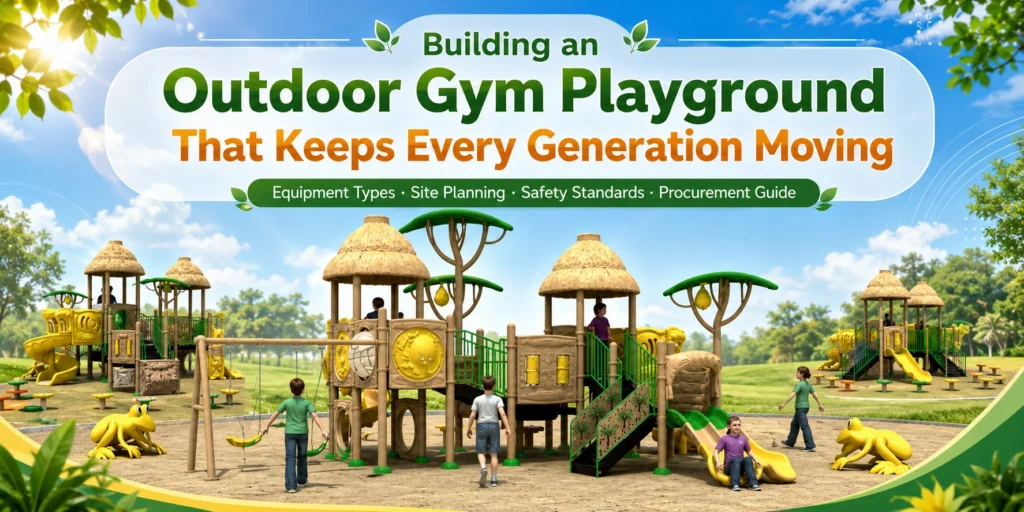
You face a common dilemma when planning an outdoor gym playground: how to choose equipment that lasts for years, meets safety standards across all age groups, and actually attracts regular use. Budget constraints and competing stakeholder demands make every decision critical. Without a structured approach, you risk selecting equipment that fails durability tests within two seasons or doesn’t comply with EN1176 surfacing requirements.
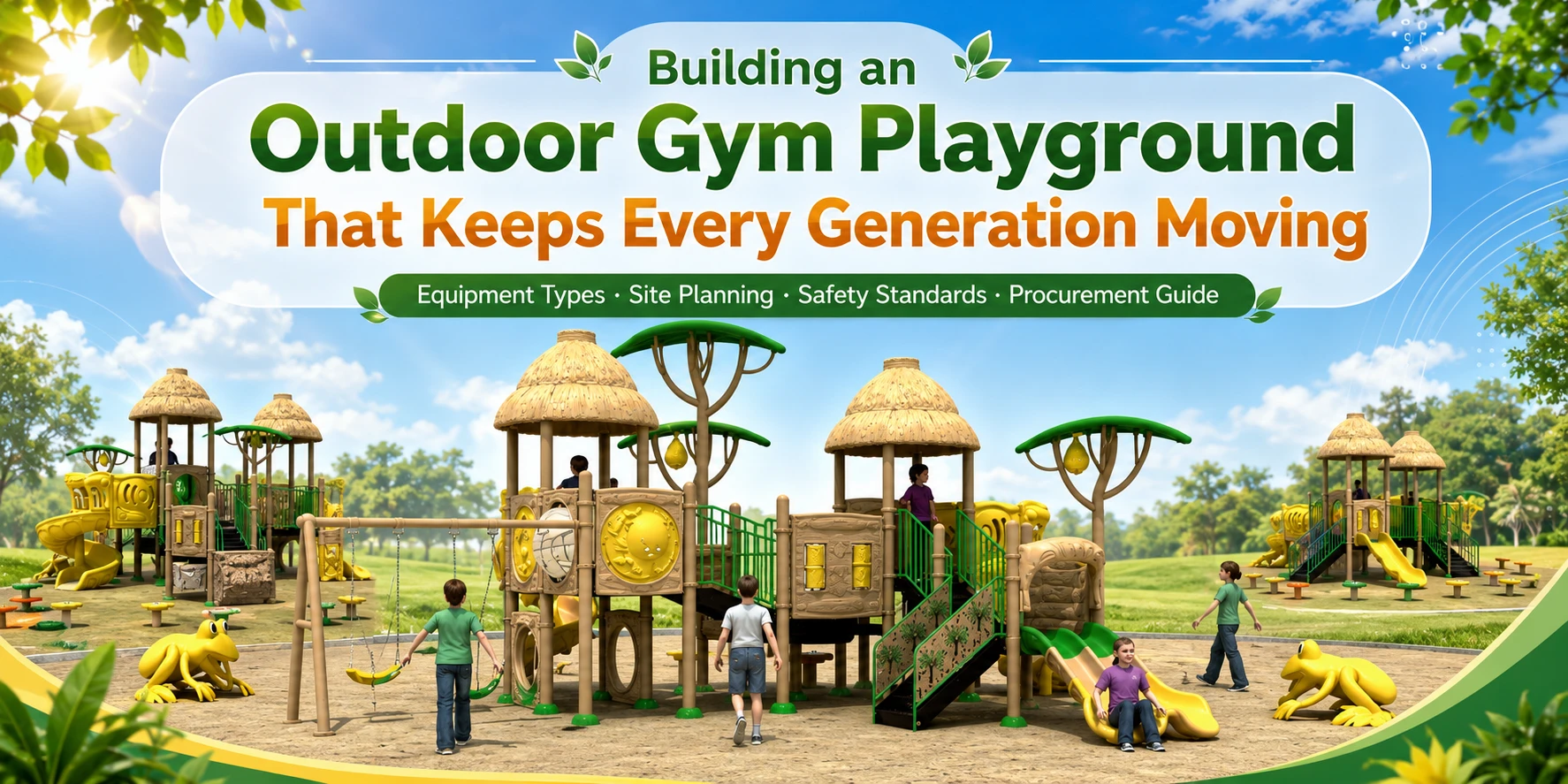
An outdoor gym playground combines fitness equipment with traditional play structures, creating a multi-use space for strength training and active recreation in parks, schools, and resorts.
This guide covers equipment types, site planning, safety standards, and procurement steps to support your playground project planning from concept to installation.
Key Equipment Types for Outdoor Gym Playgrounds
Outdoor gym playgrounds typically feature five core equipment categories that combine strength training with active play. The commercial playground planning guide you use should assess each type by user age, space footprint, and maintenance demands.
- Pull-up bars and parallel bars: Static bodyweight stations with multiple grip heights. Ideal for school fitness zones and teen-focused play areas. Expect a fall height of 1.8–2.4 m per EN1176.
- Leg presses and chest press units: Low-impact cable-free machines using the user’s body weight. Common in resort fitness circuits and senior exercise zones. Units typically serve one user at a time and require 3–4 m of clearance.
- Multi-station gyms: Compact frames with 4–6 exercise options (chin-up, row, dip, push). Suitable for parks with limited ground space. A typical 5-station unit fits within an 80–100 m² footprint.
- Combination play-fitness units: Integrated slides, climbing nets, and adult-strength bars on one structure. Used in school grounds and community parks to bridge age groups. Market data shows a 25% rise in such installations since 2021.
| Equipment Focus | Typical Space Required | User Age Group |
|---|---|---|
| Gym focus (strength/cardio) | 120–180 m² | 13+ (teens to adults) |
| Play focus (climbing, swings) | 80–120 m² | 5–12 years |
| Combination (fitness + play) | 150–250 m² | 5+ (all ages) |
Choose categories based on your target audience and available space. Recent playground site planning trends show that 35% of UK park upgrades now include dedicated senior fitness zones with low-impact leg press and seated row stations. Plan your equipment mix early to avoid costly retrofitting.
Site Planning and Safety Surfacing Essentials
Good site planning determines how well an outdoor gym playground performs over its lifetime. Start with a systematic site assessment to avoid drainage failures, shading issues, or access conflicts.
Step 1: Evaluate sunlight and drainage. Fitness equipment needs 4–6 hours of daily light to dry quickly. Avoid low-lying areas where water pools after rain. Step 2: Check accessibility. The site must have a hard-surface path (min. 1.2 m wide) to meet DDA/ADA requirements. Step 3: Confirm underground services. Request a utility survey before marking out the layout.
For layout design, zone equipment by user age and intensity. Place multi-station gyms (teen/adult) at least 3 m from toddler play sets. Maintain a minimum 1.8 m clearance zone around each piece for free movement and fall protection – this is your “use zone”.
Safety surfacing is the most critical investment. EN 1176 specifies critical fall height (CFH) thresholds that your surface must match or exceed. Below is a comparison of the three common options.
| Material | Cost (£/m² installed) | Maintenance level | Max CFH (EN 1176) | Compliance note |
|---|---|---|---|---|
| Poured-in-place rubber | £45–£70 | Low (repair only) | 2.5 m–3.0 m | Fully bonded, seamless |
| Rubber interlocking tiles | £30–£50 | Medium (replace damaged tiles) | 2.0 m–2.5 m | Requires sub-base levelling |
| Bonded wood mulch (engineered) | £20–£35 | High (top up annually) | 1.8 m–2.5 m | Loose fill, depth must be verified |
Include your chosen material’s CFH rating in the playground installation checklist – it is a common inspection fail point. Once the surface is specified, move to the safety certification requirements that validate your selections.
Understanding Safety Standards and Certification
Certification requirements vary by region, and getting them wrong can halt a project or void your insurance. In the US, playground equipment must comply with ASTM F1487 (standard for public-use play areas) and often CPSC guidelines. In the EU and many other markets, EN1176 is the mandatory standard for playground equipment. For fitness apparatus, refer to EN957 (stationary training equipment) or ASTM F3023 (strength equipment for outdoor use). The distinction matters: a pull-up bar on a playground falls under play standards, while a leg press unit must meet fitness equipment certification. Without valid third-party test reports, you risk liability claims and may lose access to government or foundation funding. Public grants typically require certified equipment and a documented playground safety surfacing plan that matches the fall height rating.
Request these documents from every supplier before purchase:
- Test report from an accredited lab showing ASTM F1487 or EN1176 compliance
- Fitness equipment certification (EN957 or ASTM F3023) if applicable
- Installation manual with anchoring, spacing, and surfacing specifications
- Certificate of conformity and declaration of performance (for EU projects)
Vet these papers against your school playground project planning requirements – missing documentation is one of the most common reasons for inspection rejection. With certified equipment procured, the next step is creating a procurement schedule and RFQ that ties safety compliance to your budget.
Procurement Guide for Outdoor Gym Playground Projects
Now that certified equipment is selected, the next step is drafting a procurement schedule that ties safety compliance to your budget. Start with a detailed RFQ that specifies materials, finishes, and warranty period. A well-written RFQ prevents costly change orders later.
RFQ essentials:
- Materials specification – galvanised steel thickness (minimum 2.5 mm for outdoor frames), aluminium vs. stainless steel fasteners, UV-stabilised polyethylene or HDPE for panels.
- Finish requirements – powder-coated colour (RAL code), anti-corrosion treatment for coastal environments.
- Warranty period – minimum 5 years on structural components, 2 years on moving parts. Ask for exclusions (e.g., vandalism, normal wear).
- Delivery terms – Incoterms (FOB or DAP), lead time in weeks, partial shipment availability.
- Installation scope – supplier provides installation team or only supervision. Specify site preparation responsibilities.
Typical budget breakdown (percentages):
| Category | Percentage of total project cost |
|---|---|
| Equipment | 45–55% |
| Safety surfacing | 25–35% |
| Site preparation & installation | 15–25% |
| Contingency (permits, inspections) | 5–10% |
Use these figures as a starting point for your playground budget planning. Actual splits vary by surfacing type and site complexity.
Timeline planning: Order lead times range from 8–16 weeks for customised units. Schedule installation during dry months (spring to autumn in most UK regions) to avoid weather delays. Allow 2–4 weeks for site preparation (ground leveling, drainage, base layer).
For sourcing, consider manufacturers with proven experience in outdoor gym playground projects. JQ Playground (Wenzhou Jiqi Amusement Equipment Co., Ltd.), founded in 1993, brings over 30 years of expertise in designing and producing commercial playgrounds. Their 60,000 m² factory houses 20+ production lines and 55 machines, staffed by 180+ skilled workers. They offer free design support, OEM/ODM capability, and can produce equipment compliant with EN1176, ASTM, and other standards. With annual output exceeding 2,000 containers, they have the capacity to meet large-scale project demands. Their 8-person design team can create a free CAD layout based on your site plan, and they provide trial installation before shipping along with a one-year warranty.
Supplier selection criteria:
1. Experience with public projects – request references from municipal or school playground installations.
2. Customisation capability – can they adapt colours, add logos, or modify equipment for disabled access?
3. Post-installation support – do they offer annual safety inspections, spare parts availability, and a technical helpline?
These factors directly affect long-term maintenance costs and user safety. With a solid RFQ and realistic budget, you can move to the final stage: closing the project handover.
About JQ Playground – playgroundprojectguide.com
JQ Playground (Wenzhou Jiqi Amusement Equipment Co., Ltd.) is a children’s playground equipment manufacturer founded in 1993. The company provides design, customization, large-scale manufacturing, sales, installation guidance, and after-sales support for outdoor playgrounds, indoor playgrounds, soft play, water playgrounds, PE board playgrounds, kindergarten furniture, outdoor fitness equipment, pet playgrounds, and playground facilities. Approved company facts include 180+ employees, a large Wenzhou production base, 20+ production lines, 55 production machines, ISO/BSCI/EN1176/EN71/ASTM/CPC/CPSIC certification references, 100+ patents, free design support, OEM/ODM capability, trial installation before shipping, export experience, and one-year quality warranty.