Planning an indoor playground is more than choosing slides and ball pits. You must balance safety standards, floor space, age ranges, and budget — usually against a fixed opening date. Get it wrong and you face costly retrofits, failed inspections, and long closures. This guide explains how indoor playground equipment works, which product types suit different projects, and how to compare manufacturers before you commit. Use it as your playground project planning checklist.
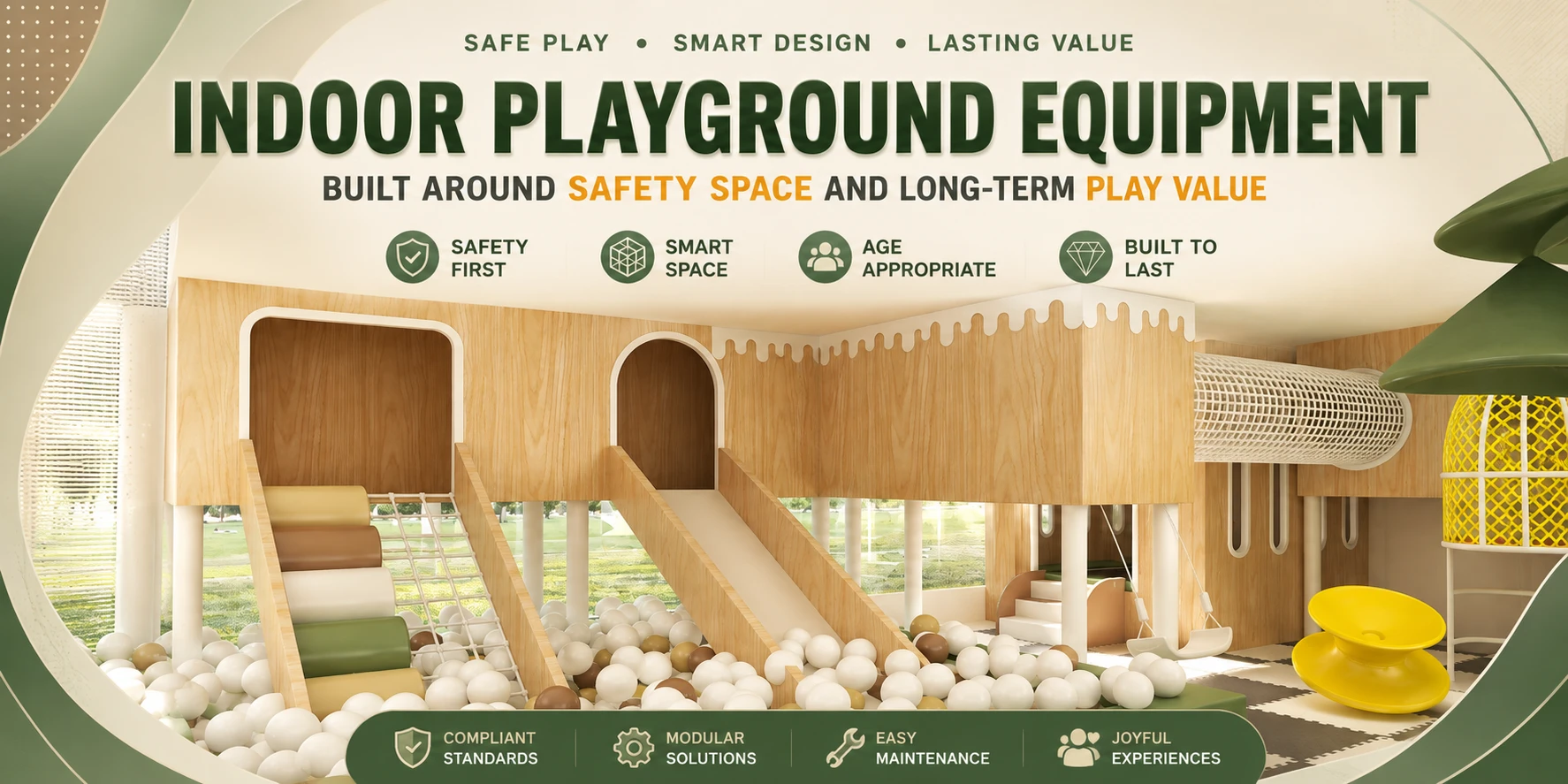
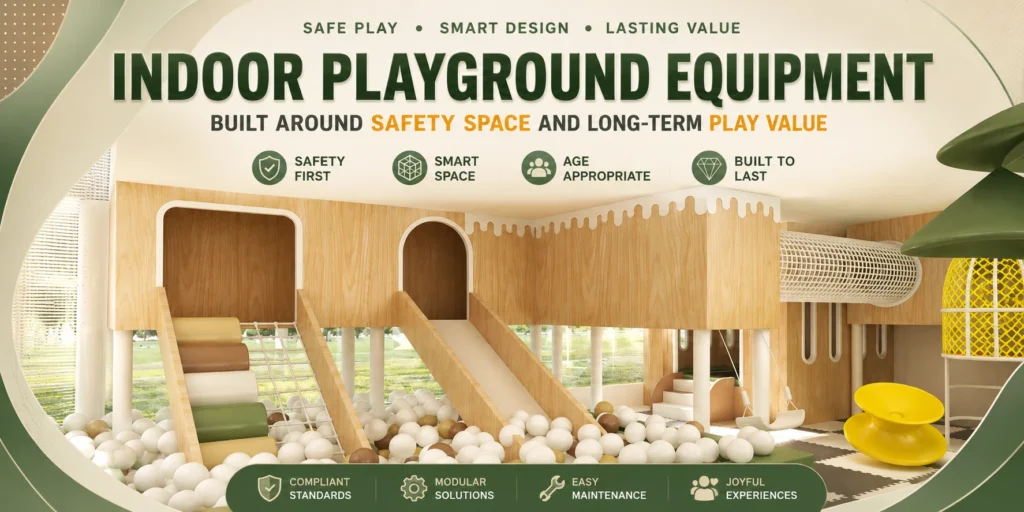
Indoor playground equipment refers to the structures, soft play components, climbing frames, slides, and safety surfacing installed inside a building to create a supervised play environment for children. It includes modular play units, ball pits, foam blocks, sensory panels, and themed soft play sets. Indoor equipment supports year-round use, protects children from weather, and must meet indoor safety and fire-resistance requirements. Buyers select systems by age range, available floor area, ceiling height, and maintenance expectations.
Here is how these systems function and what to verify before sending an RFQ.
How Indoor Playground Equipment Works
Indoor playground equipment operates as a modular assembly engineered for controlled, repeatable use. The sequence runs from the structure outward:
- Floor anchoring — steel or aluminium posts bolt to the slab and carry the entire live load.
- Deck and feature fit-out — platforms, slides, tubes and climbers attach with fixed or tooled fasteners.
- Safety surfacing — foam mats, rubber tiles or poured-in-place layers cushion every fall zone.
- Inspection cycle — welds, fasteners and impact padding follow the manufacturer’s torque and replacement schedule.
Component roles
Frames bear weight, decks create transitions, slides govern descent speed, and netting contains movement while meeting spacing rules. During playground site planning, verify that fall-height ratings match your slab and that individual parts can be reordered for repeatability.
If a supplier cannot provide a fall-height chart and torque schedule, treat the quote as incomplete.
Indoor Playground Equipment Components and Product Types
Buyers compare four structural families: foam soft play, rigid frames, impact surfacing, and activity add-ons. Each carries different compliance and maintenance costs, so compare them before requesting quotes.
| Product type | Buyer check | Typical specification |
|---|---|---|
| Soft play modules | Foam density and cover seam quality | Closed-cell foam; wipe-clean, flame-retardant covers |
| Climbing frames | Frame material and fixing style | Powder-coated steel or timber; bolt caps and anti-trap spacing |
| Slides and tubes | Curve radius, material, and joint finish | Rotomoulded HDPE or stainless steel; smooth joints |
| Ball pools | Ball volume and material grade | Around 100 balls per m²; non-toxic, seam-free PE balls |
| Trampolines | Frame gauge and enclosure padding | Weight limit per mat; padded pole and spring covers |
Add these to your playground RFQ checklist: panel thickness, fastener types, age-range signage, and cleaning protocols. Ask suppliers to confirm load ratings and maintenance intervals in writing; those figures dictate your replacement budget. Keep the same checklist when you map components to site applications.
Typical Applications for Indoor Playground Equipment
Application dictates nearly every ordering decision, so match equipment to site reality before requesting quotes.
- Municipal parks and community centres: choose high-traffic units with replaceable parts and request compliance evidence linked to your playground safety surfacing plan before sign-off.
- Schools and nurseries: zone by key stage, favour inclusive pieces, and align layouts with school playground project planning guidance for supervision sightlines.
- Resorts, cafés and retail play areas: compact themed structures work best where dwell time is short; specify easy-clean surfaces and tamper-resistant fixings.
- Indoor play centres: prioritise throughput, spare-part availability and daily disinfection compatibility.
| Application factor | Action |
|---|---|
| Footfall and age range | Match component ratings and fall-height zones |
| Space and ceiling height | Confirm footprint, clearance and installation access |
| Hygiene routine | Request material and fastener corrosion data |
Once site conditions and usage profiles are locked, the next stage is deciding how far your manufacturer can customise to those requirements.
Custom Indoor Playground Equipment Manufacturing and OEM Cooperation
Customisation starts with what you hand over: drawings, reference photos or an existing sample. From there, the work moves through five defined stages, each pairing a buyer input with a measurable manufacturer output.
| Stage | Buyer input | Manufacturer output |
|---|---|---|
| Feasibility and quote | 2D drawings or sample photos | Material, safety and cost assessment with formal quote |
| Sample confirmation | Approved pre-production sample with colour/logo notes | Locked specifications, production tooling |
| Production | Packaging style, carton markings, target quantity | Scheduled batch run with progress updates |
| Batch inspection | Inspection date or third-party checklist | Inspection report with photos and test records |
| Shipment | Delivery address, port preference | Packing list, loading photos, shipping documents |
Inspection detail worth requesting
Visual checks miss hidden faults on climbing structures. Request dimensional checks on bolt spacing, load-test certificates for platforms and netting, and pull-test records for anchoring points before packing.
That inspection record also sharpens supplier comparison and playground budget planning, which the next section covers.
Top 10 Indoor Playground Equipment Manufacturers and Supplier Fit
Project fit decides your indoor playground equipment shortlist. Match supplier type to the project role, not the brand name.
| Supplier type | Pros | Cons | Best fit |
|---|---|---|---|
| Full-service turnkey manufacturer | One contract covers design, installation and certification | Higher upfront price; longer lead times | Municipal parks and resort developers |
| Soft-play module specialist | Fast lead times, flexible zone layouts, easy expansion | Fewer outdoor-rated options | Schools and family entertainment centres |
| Ninja-course and climbing builder | Custom obstacles, strong visitor appeal | Smaller compliance track record | Fitness operators and trampoline parks |
| OEM and import wholesaler | Lowest unit price, custom colours and logos | You manage compliance evidence and freight | Contractors and budget-led buyers |
Score every candidate with one checklist:
- Request EN 1176 or ASTM F1487 certificates per zone, not per brochure.
- Ask for a playground age zone layout drawing matching your visitor ages.
- Confirm spare parts availability for at least five years.
- Demand playground closeout documents: installation manual, inspection sign-off, as-built drawings.
The cheapest quote is a starting price. Add compliance, install and spare-part costs over five years before you shortlist.
About JQ Playground – playgroundprojectguide.com
JQ Playground (Wenzhou Jiqi Amusement Equipment Co., Ltd.) is a children’s playground equipment manufacturer founded in 1993. The company provides design, customization, large-scale manufacturing, sales, installation guidance, and after-sales support for outdoor playgrounds, indoor playgrounds, soft play, water playgrounds, PE board playgrounds, kindergarten furniture, outdoor fitness equipment, pet playgrounds, and playground facilities. Approved company facts include 180+ employees, a large Wenzhou production base, 20+ production lines, 55 production machines, ISO/BSCI/EN1176/EN71/ASTM/CPC/CPSIC certification references, 100+ patents, free design support, OEM/ODM capability, trial installation before shipping, export experience, and one-year quality warranty.