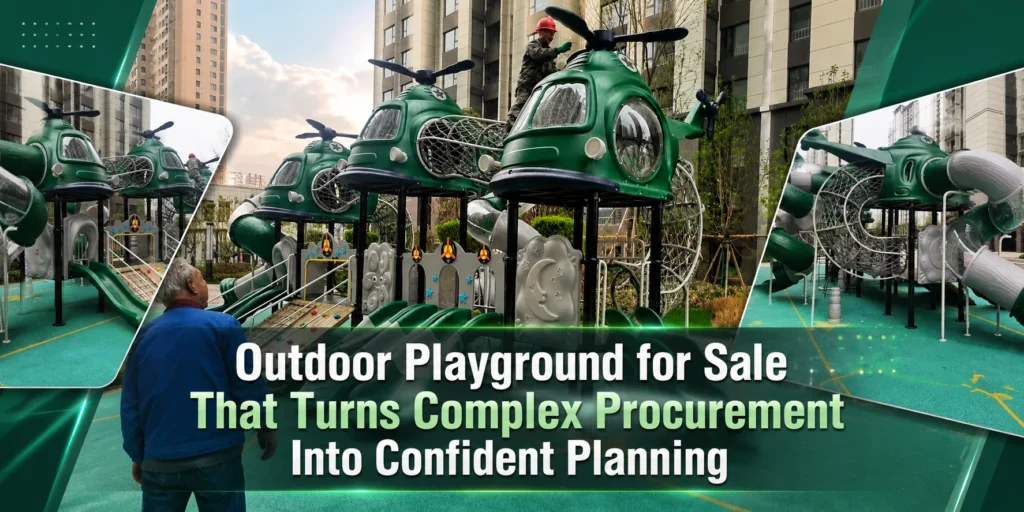
Sourcing a commercial outdoor playground involves navigating diverse equipment types, safety standards like EN1176 or ASTM, and a crowded supplier base. Procurement teams must balance budgets with durability requirements — and the choices affect safety and longevity for years.
Outdoor playground for sale describes modular play structures produced for public or commercial use: school playgrounds, community parks, or resort activity areas. Manufacturers sell these units directly to institutions, offering customisation options from colour to layout. Sizes range from small preschool sets to large multi-tower configurations.
This guide serves as a playground project guide, covering playground types, evaluation criteria, procurement steps, and installation choices. It synthesises the essentials for effective playground project planning.
Commercial Outdoor Playground Types by Application and Age Group
The equipment you select depends heavily on the children who will use it. Age group, physical ability, and the play environment all influence the right design. Below are the four main categories found in any commercial playground planning guide.
School-Age Playgrounds (Ages 5–12)
These structures prioritise challenge and social interaction. Typical equipment includes overhead climbers, horizontal ladders, slides over 1.8 m long, and multi-level platforms. Deck heights reach 1.5–2.4 m, with recommended use zones of 400–1200 square feet per structure. Customisation is moderate: you can choose colour schemes, add climbing walls, or integrate fitness stations. Steel posts with powder coating are standard for durability.
Preschool and Toddler Playgrounds (Ages 2–5)
Smaller, lower structures with maximum fall heights of 1.5 m. Equipment features short slides (under 1.2 m), crawl tunnels, low platforms (under 0.6 m), and bucket swings. The footprint typically spans 100–400 square feet. Customisation is limited to colour and a few themed panels because safety standards tightly control dimension ranges. Coated metal and rotomoulded plastic are common materials.
Inclusive and Accessible Playgrounds
Designed so that children of all abilities can play together. Key elements include ramps (1:12 slope recommended), transfer platforms, tactile panels, and ground-level activity centres. Sizes vary widely, but a minimum accessible route width of 1.5 m is standard. Customisation often involves sensory components, quiet zones, and wheelchair-accessible swings. Some manufacturers offer 100% custom layouts for site-specific needs.
Custom Themed Playgrounds
These are fully bespoke structures replicating a theme – a pirate ship, castle, or local landmark. Equipment is built around the narrative, so dimensions and components are unique. You may specify any colour, texture, or material within structural limits. Lead times are longer (12–20 weeks), and the budget is typically 30–50% higher than a standard catalogue model. Good playground site planning is essential to match the theme to the available area.
| Age Group | Typical Area | Key Equipment |
|---|---|---|
| 2–5 | 100–400 sq ft | Low slides, tunnels, bucket swings |
| 5–12 | 400–1200 sq ft | Overhead climbers, tall slides, ladders |
| Inclusive | Varies (150–800 sq ft) | Ramps, sensory panels, transfer platforms |
| Custom Themed | Site-dependent | Fully bespoke elements and colours |
Essential Evaluation Criteria for Outdoor Playground Buyers
When sourcing an outdoor playground for sale, six core criteria separate a safe, durable investment from a costly mistake. Evaluate every supplier against these standards before adding them to your playground RFQ checklist.
Safety compliance. Confirm the equipment meets ASTM F1487 and CPSC guidelines (North America) or EN1176 (Europe). A compliant design will specify a maximum fall height of 2.4 metres for standard school-age slides and include guardrails at the correct heights. Do not rely on sales claims – request copies of third-party test reports for every component.
Material quality. Look for galvanised steel posts with a minimum zinc coating weight of 350 g/m² (often called “commercial grade”). High-density polyethylene (HDPE) panels should be UV-stabilised, not simply spray-painted. Rotomolded plastic parts must show even wall thickness with no thin spots; a 0.25-inch minimum is common in commercial sets.
Durability and weather resistance. The structure should tolerate direct sun, rain, frost, and salt air without cracking or fading for at least 10 years. UV stabilisers added during moulding (not just a top coat) prevent brittleness. Ask suppliers for accelerated weathering test data (e.g., ASTM G155 for xenon-arc exposure).
Warranty terms. Compare lengths: 15 years on galvanised steel frames, 5 years on HDPE panels, and 1–2 years on moving parts (chains, springs) is typical. Read exclusions – “weather damage” language can void coverage for sun bleaching or freeze cracking.
Supplier reputation. Ask for at least three references from similar projects (school, park, resort). Talk to those buyers about on-time delivery, missing parts frequency, and post-installation support. Cross-check online review platforms and trade association memberships. For example, JQ Playground (Wenzhou Jiqi Amusement Equipment Co., Ltd.) has been manufacturing children’s playground equipment since 1993, with 180+ employees and a 60,000 sqm production base. Their products are certified to EN1176, ASTM, and other international standards, and they offer free CAD-based design, trial installation before shipping, and a one-year warranty. Such indicators of a well-established manufacturer can simplify your vetting process.
Before committing, request full test reports for safety certification and material composition, plus contact details for three recent buyers. This spot-check alone will separate legitimate manufacturers from resellers of substandard kits. Skipping this step often leads to re-ordering parts or redoing installation – two items already on your playground installation checklist.
Navigating the RFQ and Procurement Process for Playground Equipment
After vetting supplier credentials, shift to a structured four‑step procurement sequence.
1. Define project specifications. Record site dimensions, target age group (e.g., 2–5 or 5–12), and budget. Include your playground safety surfacing plan – the surfacing type affects fall‑height requirements and foundation costs.
2. Issue an RFQ to three to five suppliers. Provide your spec sheet and desired delivery date. Request a quote on price, lead time, shipping, and installation. Crucially, ask for a site survey. An incomplete site survey is a common pitfall – without it, you risk a structure that does not fit your site’s drainage or grading.
3. Evaluate proposals systematically. Compare total cost (including freight and preparation fees), warranty length, and delivery timeline. In a school playground project planning scenario, favour proposals that offer phased delivery so the playground opens before all extras are installed.
4. Finalise the contract with explicit milestones. Include delivery dates, payment stages, warranty terms (e.g., 10 years steel, 3 years moving parts), and liability clauses. Make final payment conditional on a post‑installation safety inspection.
Installation and Surfacing Choices for Delivered Playground Sets
The surface under your play structure is as critical as the equipment itself. Impact-attenuating surfacing must meet ASTM F1292 or EN 1177 standards to reduce injury risk. Three primary options suit commercial settings, each with distinct trade-offs for your park playground project guide.
Poured-in-place rubber (PIP) delivers a seamless, slip-resistant surface with excellent impact absorption and wheelchair accessibility. It lasts 10–15 years with minimal maintenance. The downside: higher upfront cost (£30–£60 per square metre installed) and professional installation required. Repairs for damage or colour fading can be difficult and expensive.
Engineered wood fibre (EWF) is the most cost-effective option, costing roughly £5–£15 per square metre. It provides natural aesthetics and decent impact performance when maintained at the correct depth (≥300 mm). However, EWF compresses over time, needs regular topping-up, and is not wheelchair-friendly unless combined with mats or a firm base. It also requires thorough drainage planning.
Rubber tiles offer a modular middle ground. They are easier to install and replace individually if damaged. Safety performance is reliable, and tile designs allow custom colours. Weaknesses include potential shifting over time if the base is uneven, and a higher installed cost than EWF (roughly £20–£40 per square metre). Regular inspection of joints is necessary.
Site preparation precedes any surfacing. You must grade the area to prevent pooling water and install a geotextile membrane and sub-base (typically 100–150 mm of crushed stone) for drainage and stability. Many suppliers offer installation as an add-on service, but some specify use of approved third-party contractors to maintain warranty coverage. When planning your playground budget planning, factor in both surface materials and preparation costs — they can represent 20–35 % of total project spend. Always confirm whether installation is included or outsourced before signing the contract.
About JQ Playground – playgroundprojectguide.com
JQ Playground (Wenzhou Jiqi Amusement Equipment Co., Ltd.) is a children’s playground equipment manufacturer founded in 1993. The company provides design, customization, large-scale manufacturing, sales, installation guidance, and after-sales support for outdoor playgrounds, indoor playgrounds, soft play, water playgrounds, PE board playgrounds, kindergarten furniture, outdoor fitness equipment, pet playgrounds, and playground facilities. Approved company facts include 180+ employees, a large Wenzhou production base, 20+ production lines, 55 production machines, ISO/BSCI/EN1176/EN71/ASTM/CPC/CPSIC certification references, 100+ patents, free design support, OEM/ODM capability, trial installation before shipping, export experience, and one-year quality warranty.