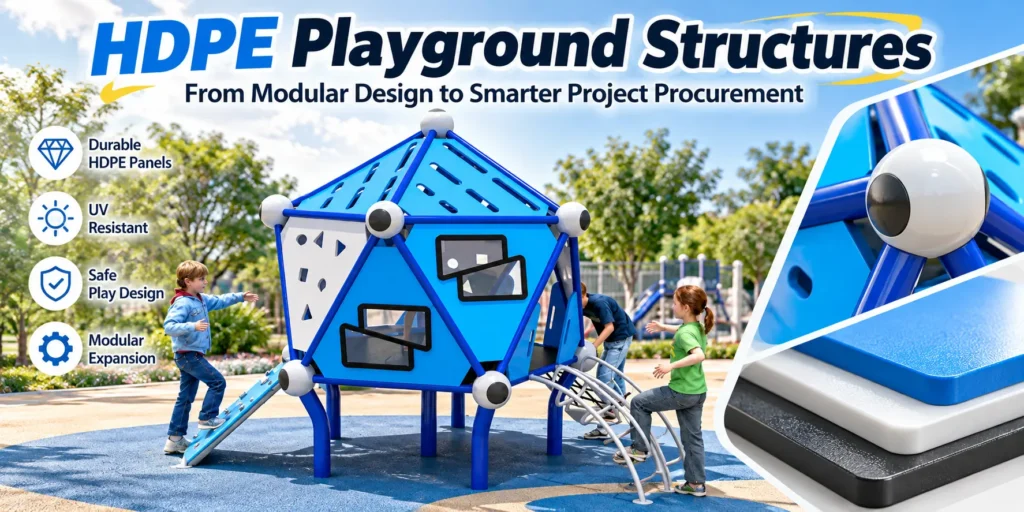
A park, school or resort team that has shortlisted HDPE playground structures must reconcile supplier listings that use different model codes, unit sizes and configuration labels. JQ Playground, the international trade brand of Wenzhou Jiqi Amusement Equipment Co., Ltd., has manufactured children’s playground equipment since 1993, and the comparison steps below are the ones buyers raise most often before an RFQ.
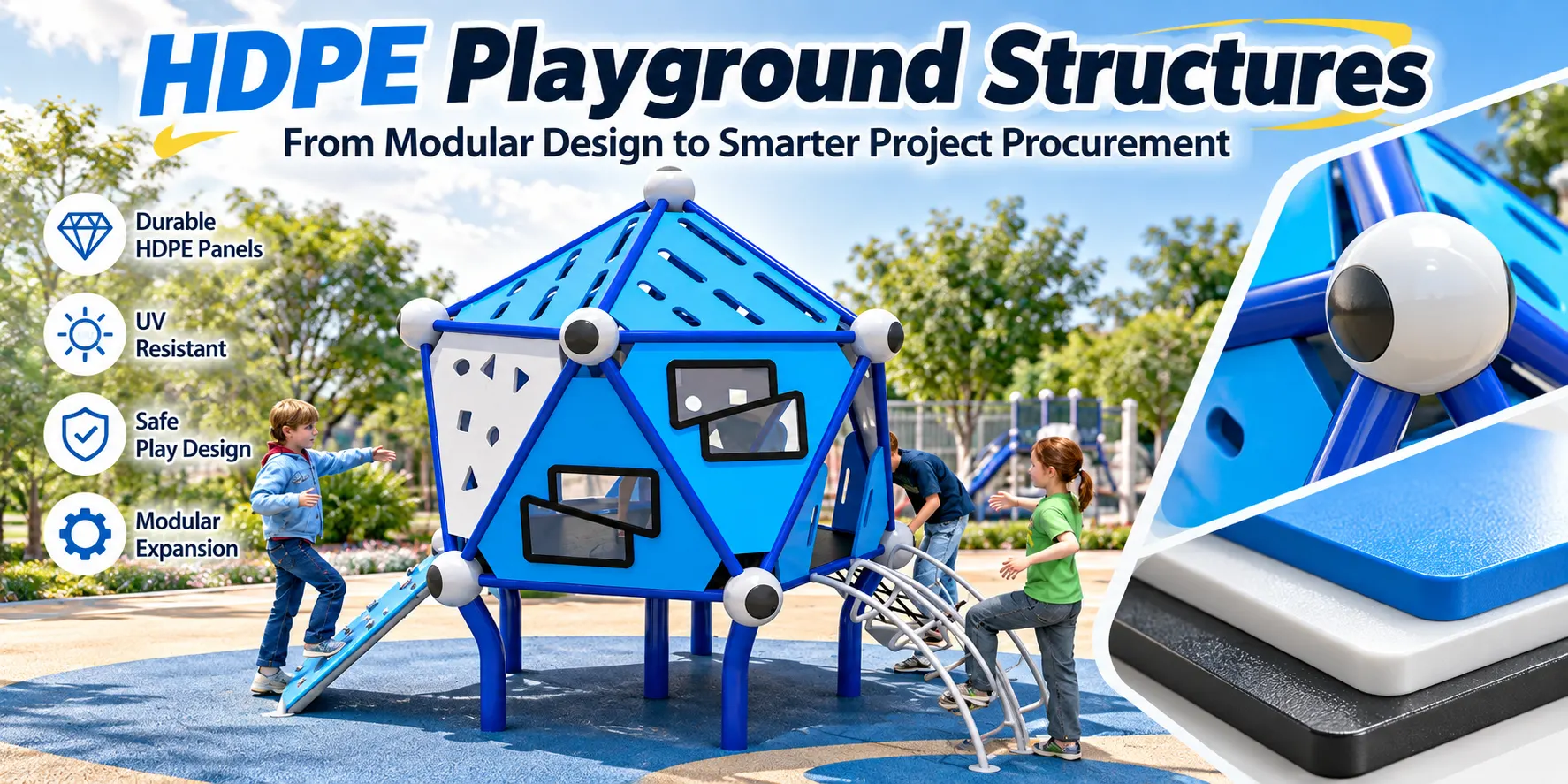
HDPE playground structures are outdoor play units built from high-density polyethylene panels, posts and connectors, often labelled DHPE on supplier pages. The aim is a like-for-like comparison before you request pricing.
This playground project guide walks through product anatomy, specification fields, material trade-offs, layout zoning and quotation checks.
How HDPE Playground Structures Are Assembled: Panels, Posts, and Connectors
Panel-based builds begin with load-bearing posts — galvanised or powder-coated steel, aluminium, or HDPE-clad — set into the surfacing. Coloured HDPE side panels fix between posts using stainless or nylon connectors, forming walls, guardrails and roof lines. Deck platforms bolt at published heights, with slides and roofs added as separate sub-assemblies.
Because each panel is discrete, a vandalised or worn section can be replaced individually. Pasted-on graphics and bonded components cannot; you re-order the whole sub-assembly.
Typical component families on supplier listings:
- Side panels (coloured HDPE, often named by profile or panel code)
- Posts and post caps (steel, aluminium or clad)
- Deck platforms and guardrails
- Slides, roofs and activity inserts
- Connectors, bolts and nylon hardware
Modular category pages group these by bay or deck count, so you can add panels later without replacing posts. On any bay-built system, request the post schedule alongside the panel list, because the post layout — not the panel count — is what constrains future expansion. JQ Playground trial-installs units before shipping, so panel codes and connector sets are matched to the post schedule in the factory rather than discovered missing on site.
Spec Fields to Pull From a DHPE Product Page: Dimensions, Deck Heights, and Age Ratings
Seven fields decide whether a unit fits your site. Extract them into one row per model before you compare pricing; where a supplier offers free CAD layout work against your site file, use it at this stage so each field is checked against the real pad.
| Spec field | Why it matters | What listings typically show |
|---|---|---|
| Overall unit size (cm/ft) | Gate access, pad size, slab dimensions | L × W × H in cm, with a rounded ft figure |
| Deck height | Sets guardrail type and required surfacing depth | Platform height, e.g. 90 cm or 120 cm |
| Age group | 2–5 vs 5–12 changes deck height, rail height, capacity | A bracket label, rarely with the reasoning |
| User capacity | Matches throughput to expected footfall | “Up to X children” |
| Component count | Proxy for play value and panel complexity | Count of slides, panels, climbers |
| Model code | The only identifier that survives revisions | Alphanumeric code, sometimes with bay number |
| Safety-zone footprint | Usually larger than the unit itself | Often missing, or conflated with unit size |
Two traps recur. First, cm-to-ft figures are rounded — a 244 cm deck becomes “8 ft”, a small gap that matters when the pad is tight. Second, safety-zone area differs from unit size: the falling space typically extends well beyond the perimeter and grows with deck height. Add both to your playground installation checklist before the site survey.
HDPE vs. Wood, Steel, and Recycled Plastic: Weather, UV, and Play-Surface Behavior
HDPE playground structures hold moulded colour without repainting; UV-stabilised panels fade gradually rather than chalk or grey. Timber darkens and typically needs a re-coat every one to two years. Steel frames stay rigid, yet rust begins at scratched welds and chipped fixings — specify galvanised or stainless hardware. Recycled plastic resists rot but often shows a mottled finish and more flex in thin sections.
Under direct sun, timber splinters and bare steel handrails get hot enough to need shade or cladding; HDPE stays touch-comfortable and wipes clean with soapy water. Each material still earns its place: timber for natural-themed settings, steel for high-traffic climbing frames, recycled plastic for boardwalk-style elements. Where a project mixes materials, ask which items in the quote are PE board and which are timber or steel, since installation labour and re-coat cycles differ. Weigh that mix into your playground safety surfacing plan before layout work begins.
Age-Zoned and Modular Layouts for Parks, Schools, and Resorts
Split the site into a 2–5 toddler zone and a 5–12 zone with separate sightlines. Keep toddler exit paths away from junior swing lines. Surfacing depth follows critical fall height, so specify each zone separately. Specify HDPE playground structures as bay-based modular frames, so you can add a 3 m bay later without moving posts — useful for phased playground budget planning. Testing the toddler/junior split on a free CAD layout, before surfacing is priced, is the cheapest point to change your mind.
- Park: place a 6 m × 8 m toddler bay beside seating; add two shade roofs over decks.
- Schoolyard: use an L-shaped small-footprint run, a 1.2 m accessible route and a transfer platform at the junior deck.
- Resort: roof the toddler bay, screen the 5–12 zone from pool paths and keep both zones within one sightline.
What Published Sizes and FOB Prices Cover — and What an RFQ Should Confirm
Published FOB prices normally cover the structure only. A listed figure usually stops at the factory and leaves out rubber surfacing, sea freight, duty, installation labour, and site preparation. The unit size quoted is not the safety-zone footprint: a 620 × 450 cm unit can need a 9.2 × 7.5 m safety-zone area once fall-height clearances are applied. Lock these down in the RFQ:
- Model code and revision.
- Exact unit and safety-zone dimensions in cm and ft.
- Age group and user capacity, matched to your playground age zone layout.
- Material and post specification.
- Colour and panel options.
- Packing volume and container load.
- Installation scope, including whether factory engineers travel to the destination country.
- Whether the unit is trial-assembled before packing, and which assembly drawings ship with it.
- Acceptance criteria on delivery, including playground closeout documents.
Project Support Before the RFQ: CAD Layout, Trial Assembly, and Export Packing
JQ Playground (Wenzhou Jiqi Amusement Equipment Co., Ltd.) is a children’s playground equipment manufacturer based in Wenzhou, Zhejiang, China, founded in 1993. The production base covers 60,000 sqm with 20+ production lines, 55 machines and 180+ skilled workers, and 10 production lines can support delivery of one 40HQ container within three days. Eight QC checkpoints cover the full production flow. Layouts are drawn free in CAD by an eight-person design team, revisions are free, units are trial-installed before shipping, and engineers can be sent to the destination country for assembly.
For a shortlisted HDPE playground structures comparison, that means you can request a layout, a packing plan and assembly drawings before committing to an RFQ. Send your site file and shortlist to JQ Playground to start the layout review.