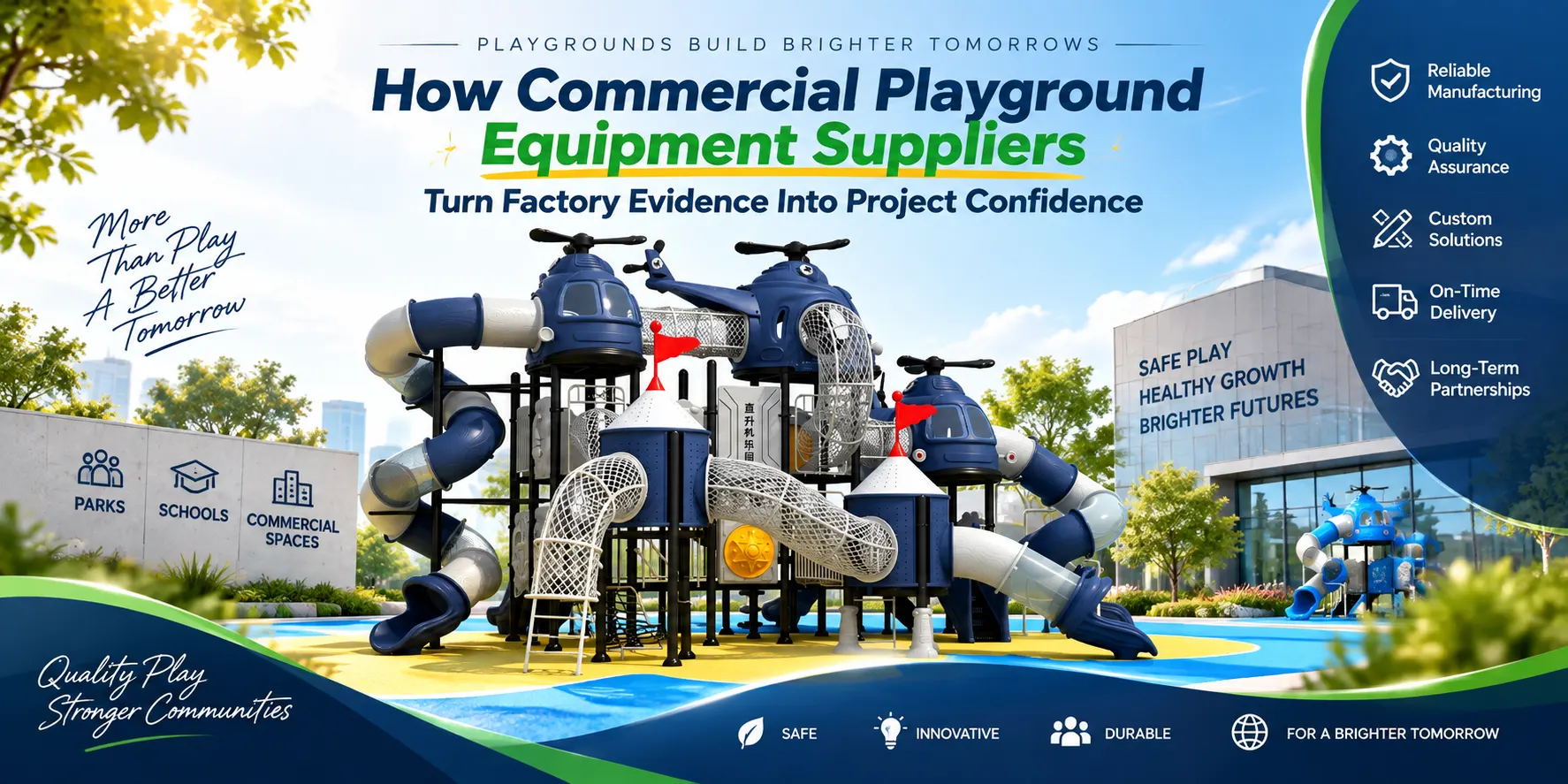

A playground project rarely fails on installation day. It fails earlier, when a supplier confirms a build and then delivers frames that do not match the drawings, parts that need re-ordering, and paperwork procurement cannot file. Each gap costs weeks. Most of those gaps trace back to how the supplier was chosen, not to the design. Compare commercial playground equipment suppliers on manufacturing scope, calibration records, and sample approval rather than catalogue polish. A written playground project planning checklist removes more risk than a lower unit price ever will.
Commercial playground equipment suppliers are businesses that manufacture, assemble, or distribute play structures — slides, climbing frames, swings, and impact-absorbing surfacing — built for public parks, schools, and commercial settings. Buyers assess them on production scope, material grades, safety documentation, installation support, and lead-time reliability rather than on range size alone.
Supplier type shapes everything that follows: capacity, documentation, and buyer fit.
Commercial Playground Equipment Suppliers: Supplier Landscape and Buyer Fit
Commercial playground equipment suppliers split into four practical archetypes. A project-focused manufacturer that fabricates, coats and assembles the full structure under one roof suits most buyers, because one team owns the documentation trail.
- Profile-fit project manufacturer — Pros: single paperwork chain from steel to surfacing. Cons: bespoke colours extend lead time. Best fit: school and municipal tenders wanting one accountable party.
- Category specialist — Pros: deep range in one product type, such as swings or climbing frames. Cons: you coordinate several vendors per site. Best fit: phased park upgrades.
- Trading company — Pros: fast quotes and mixed catalogues. Cons: thin manufacturing evidence. Best fit: small spare-part orders.
- Local fabricator — Pros: short delivery and easy site visits. Cons: limited export paperwork. Best fit: domestic contracts.
Whichever route fits, request the same evidence bundle before your playground site planning brief goes to tender.
What Buyers Should Check Before Sourcing From Commercial Playground Equipment Suppliers
Before an RFQ leaves your desk, confirm four points: who fabricates the steel, what a paid sample proves, how minimum order volumes flex across project phases, and whether shipping dates hold. A short playground RFQ checklist keeps supplier comparisons honest:
| Evidence to request | What it confirms |
|---|---|
| In-house process list | Cutting, bending and welding happen on site, not via traders |
| Jig and tolerance records | Posts, decks and clamps align across repeat orders |
| Sample approval photos | Finish matches the approved colour and coating |
| Packaging specification | Coated parts survive freight without chipping |
| Batch and load-test reports | Traceable numbers for the safety file |
| Lead time and shipping terms | Phased installations stay on programme |
Order a sample of the component you will buy most. One clamp reveals weld quality faster than a brochure. Category depth then shows which supplier can cover your full equipment list.
Commercial Playground Equipment Categories That Reveal Manufacturer Capability
Category depth is the clearest signal of what a supplier actually builds rather than resells. Ask for the bill of materials behind each range, not a photo gallery.
| Category | Capability proof | Verify with the supplier |
|---|---|---|
| Composite play structures (decks, towers, roofs) | In-house cutting, coating, and hardware supply | Post wall thickness, bolt grade, joint detail |
| Swing frames and seat assemblies | Welded steel formation, chain and bearing sourcing | Weld finish, bay spacing figures |
| Slides, nets, and climbing panels | Rotational moulding plus rope tensioning methods | Panel thickness, net fixing method |
| Safety surfacing and edging | Tile, wet-pour, or loose-fill containment supply | Fall-height match, kerb fixing depth |
Match surfacing ranges against your playground safety surfacing plan, because impact performance depends on fall heights and sub-base preparation, not on tile colour alone.
Any row you can confirm with a drawing, load figure, or test sheet narrows your shortlist quickly. A supplier brokering only part of the list will quote those lines as pass-through items.
OEM, Packaging, and Custom Cooperation With Commercial Playground Equipment Suppliers
Once drawings and test sheets confirm capability, the next checks sit in the order process. A supplier handling OEM work should show a clear handover at each stage, not just a catalogue page.
| Stage | Buyer Input | Manufacturer Output |
|---|---|---|
| Drawing or sample | Site plan, CAD drawing, component sample, colour reference | Feasibility note, revised drawing, tooling lead time |
| Quote confirmation | Target quantity, packaging style, delivery window | Fixed quotation with batch plan and lead time |
| Sample approval | Signed colour, logo, and finish approval | Pre-production sample with photo record |
| Packaging | Logo artwork, carton marks | Printed cartons and label check |
| Batch inspection | Test criteria and sampling level | Load test data, coating check, batch report |
| Shipment | Shipping marks and forwarder details | Packing list and loading photos |
This stage-by-stage record supports playground budget planning and gives your park playground project guide a traceable approval trail before the next quality request.
Quality Evidence to Request From Commercial Playground Equipment Suppliers
Ask for documents, not adjectives. A sourcing-ready manufacturer keeps measurable records; a catalogue seller sends photos of finished stock only.
Request these artefacts before approving a pilot order:
- Calibration records — dated entries showing measuring instruments checked against a traceable reference, with the next due date visible.
- Pull-force data — test values recorded against the declared crimping range or cutting capacity, not a single pass figure.
- Die wear checks — inspection logs noting wear limits and replacement intervals for each die set used on your terminal or cable type.
- Sample photos — before-and-after images of your sample, including terminal seating, burrs, and cable end finish.
- Batch reports — per-lot inspection sheets linking material, quantities, and pass or fail results to a shipment.
These records also feed playground closeout documents and playground age zone layout sign-off packs.